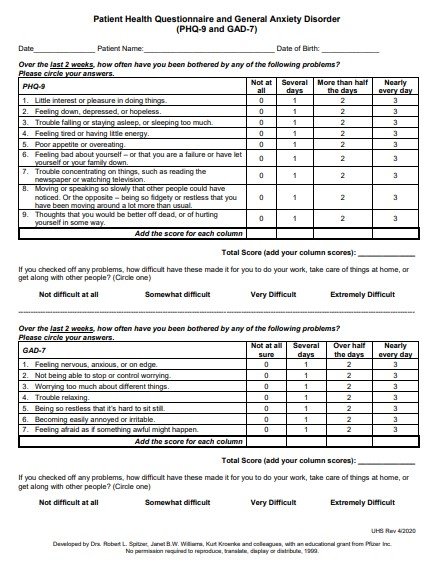
The PHQ-9 and GAD-7 pdf are widely used, self-reported questionnaires designed to measure the presence and severity of depression and anxiety, respectively. Because they are brief, easy to score, and aligned with standard diagnostic criteria (DSM-5), they are highly valuable in both clinical practice and research for diagnosing conditions and tracking treatment progress over time.
1. The PHQ-9 (Patient Health Questionnaire-9)
Purpose: Assesses the severity of depression symptoms.
How it Works: It consists of 9 questions targeting common depression symptoms (e.g., low mood, sleep issues, exhaustion, changes in appetite, difficulty focusing, and thoughts of self-harm) experienced over the past two weeks.
Scoring: Each item is graded on a scale of 0 (“Not at all”) to 3 (“Nearly every day”). The maximum possible score is 27.
Score Interpretation:
| Total Score | Severity Level | Clinical Recommendation |
| 0–4 | Minimal | Natural mood fluctuations; monitor if symptoms persist. |
| 5–9 | Mild | Daily function is likely unimpaired; supportive interventions may help. |
| 10–14 | Moderate | Noticeable impact on daily life; therapy or counseling may be recommended. |
| 15–19 | Moderately Severe | Significant interference with life; professional intervention (therapy/medication) recommended. |
| 20–27 | Severe | Severe impairment; urgent intervention and potential referral to a specialist required. |
2. The GAD-7 (Generalized Anxiety Disorder-7)
Purpose: Evaluates the presence and intensity of generalized anxiety disorder.
How it Works: It contains 7 questions focusing on anxiety symptoms (e.g., excessive worry, restlessness, bodily tension, irritability, and sleep disruption) over the past two weeks.
Scoring: Like the PHQ-9, items are scored from 0 to 3. The maximum possible score is 21.
Score Interpretation:
| Total Score | Severity Level |
| 0–4 | Minimal |
| 5–9 | Mild |
| 10–14 | Moderate |
| 15–21 | Severe |
Important Clinical Considerations
- Communication & Tracking: These tools bridge the communication gap between patients and medical professionals, making it easier to track how symptom intensity changes over the course of a treatment plan.
- Not a Stand-Alone Diagnosis: While highly accurate, high scores on the PHQ-9 or GAD-7 are not definitive diagnoses on their own. False positives and negatives can occur.
- Holistic Evaluation Required: Medical professionals must interpret these scores alongside clinical judgment, considering a patient’s medical history, potential substance use, and current environmental or situational stressors.