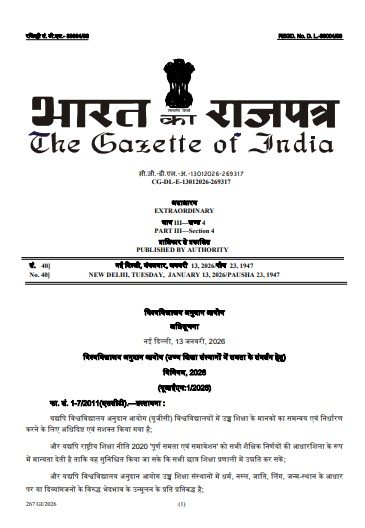
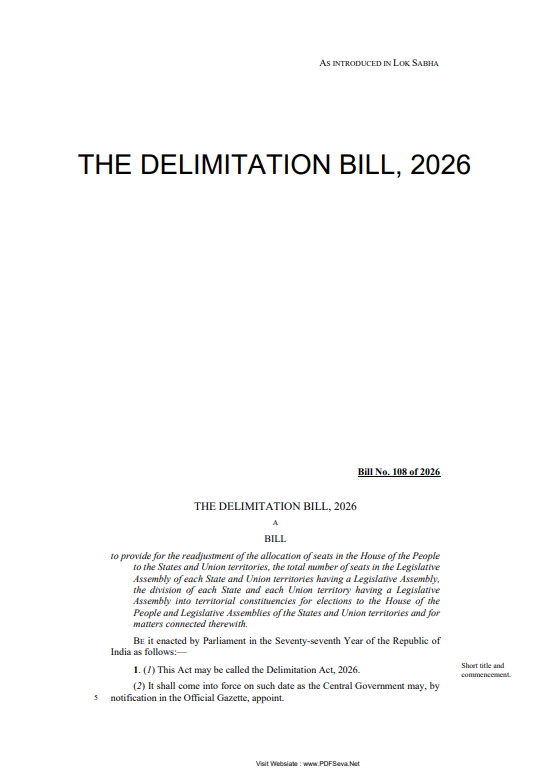
Delimitation Bill 2026: Explanation, Highlights, and PDF Download: The delimitation bill 2026 is a significant legislative proposal aimed at redrawing electoral boundaries and reallocating seats in India’s Lok Sabha and State Legislative Assemblies. It seeks to align political representation with the latest population data while introducing structural reforms, including reserved seats for women.
This Bill addresses long-standing imbalances caused by outdated census-based seat allocation. By updating constituencies and representation, it aims to ensure a more equitable and modern electoral system. It also lays the foundation for implementing women’s reservation in Parliament and State Assemblies.
Meaning and Overview of Delimitation Bill 2026
The delimitation bill 2026 provides the legal framework for:
- Reallocating seats in the House of the People (Lok Sabha)
- Adjusting the number of seats in State Legislative Assemblies
- Redrawing constituency boundaries across India
- Introducing reservation for women in elected bodies
Delimitation refers to the process of defining electoral constituency boundaries based on population changes. This process ensures that each constituency represents a roughly equal number of people, maintaining fairness in democratic representation.
The Bill replaces the earlier Delimitation Act, 2002, and empowers a newly constituted Delimitation Commission to carry out this exercise using the latest census figures.
Highlights of Delimitation Bill 2026
Several important provisions define the scope and impact of this Bill:
- Creation of Delimitation Commission
A central authority led by a Supreme Court judge, along with Election Commission members and State Election Commissioners. - Use of Latest Census Data
Seat allocation and constituency boundaries will be based on updated population figures. - Reservation for Women (Approx. 33%)
One-third of seats in Lok Sabha and State Assemblies will be reserved for women, including those from SC/ST categories. - Rotation of Reserved Seats
Women’s reserved constituencies will rotate across elections to ensure fair distribution. - Final and Binding Decisions
Orders issued by the Commission will have the force of law and cannot be challenged in court. - Public Participation
Draft proposals will be published, and objections or suggestions will be invited before final decisions.
Key Concepts Explained
1. Delimitation Commission
The Commission is the core authority responsible for implementing the Bill. It has powers similar to a civil court, allowing it to:
- Summon witnesses
- Request official documents
- Conduct hearings
It also works with associate members (MPs and MLAs) and technical experts.
2. Seat Allocation
The Commission determines:
- Number of Lok Sabha seats for each State and Union Territory
- Number of Assembly seats in each State
- Reserved seats for SC, ST, and women
If a State is allocated only one Lok Sabha seat, the entire State becomes a single constituency.
Projected number of seats based on the 2011 Census
| State/UT | 2011Population | Current Seats (as per the 1971 Census) | Projections based on 2011 Census | ||||||
| Total Seats Unchanged | Seats increase by 50% | ||||||||
| Seats | % Share | Projected Seats | Increase (+) /Decrease (-) | % share | Projected Seats | Increase (+) /Decrease (-) | %share | ||
| Andaman & Nicobar Islands | 3,80,581 | 1 | 0.18% | 1 | 0 | 0.18% | 1 | 0 | 0.12% |
| Andhra Pradesh | 8,45,80,777 | 42 | 7.73% | 38 | -4 | 6.93% | 56 | 14 | 6.89% |
| Arunachal Pradesh | 13,83,727 | 2 | 0.37% | 2 | 0 | 0.36% | 2 | 0 | 0.25% |
| Assam | 3,12,05,576 | 14 | 2.58% | 14 | 0 | 2.55% | 21 | 7 | 2.58% |
| Bihar | 10,40,99,452 | 40 | 7.37% | 46 | 6 | 8.39% | 69 | 29 | 8.49% |
| Chandigarh | 10,55,450 | 1 | 0.18% | 1 | 0 | 0.18% | 1 | 0 | 0.12% |
| Chhattisgarh | 2,55,45,198 | 11 | 2.03% | 11 | 0 | 2.01% | 17 | 6 | 2.09% |
| Dadra & Nagar Haveli | 3,43,709 | 1 | 0.18% | 1 | 0 | 0.18% | 1 | 0 | 0.12% |
| Daman & Diu | 2,43,247 | 1 | 0.18% | 1 | 0 | 0.18% | 1 | 0 | 0.12% |
| Goa | 14,58,545 | 2 | 0.37% | 2 | 0 | 0.36% | 2 | 0 | 0.25% |
| Gujarat | 6,04,39,692 | 26 | 4.79% | 27 | 1 | 4.93% | 40 | 14 | 4.92% |
| Haryana | 2,53,51,462 | 10 | 1.84% | 11 | 1 | 2.01% | 17 | 7 | 2.09% |
| Himachal Pradesh | 68,64,602 | 4 | 0.74% | 3 | -1 | 0.55% | 5 | 1 | 0.62% |
| Jammu & Kashmir | 1,25,41,302 | 6 | 1.10% | 6 | 0 | 1.09% | 8 | 2 | 0.98% |
| Jharkhand | 3,29,88,134 | 14 | 2.58% | 15 | 1 | 2.74% | 22 | 8 | 2.71% |
| Karnataka | 6,10,95,297 | 28 | 5.16% | 27 | -1 | 4.93% | 41 | 13 | 5.04% |
| Kerala | 3,34,06,061 | 20 | 3.68% | 15 | -5 | 2.74% | 22 | 2 | 2.71% |
| Lakshadweep | 64,473 | 1 | 0.18% | 1 | 0 | 0.18% | 1 | 0 | 0.12% |
| Madhya Pradesh | 7,26,26,809 | 29 | 5.34% | 32 | 3 | 5.84% | 48 | 19 | 5.90% |
| Maharashtra | 11,23,74,333 | 48 | 8.84% | 50 | 2 | 9.12% | 75 | 27 | 9.23% |
| Manipur | 28,55,794 | 2 | 0.37% | 2 | 0 | 0.36% | 2 | 0 | 0.25% |
| Meghalaya | 29,66,889 | 2 | 0.37% | 2 | 0 | 0.36% | 2 | 0 | 0.25% |
| Mizoram | 10,97,206 | 1 | 0.18% | 1 | 0 | 0.18% | 1 | 0 | 0.12% |
| Nagaland | 19,78,502 | 1 | 0.18% | 1 | 0 | 0.18% | 1 | 0 | 0.12% |
| NCT of Delhi | 1,67,87,941 | 7 | 1.29% | 7 | 0 | 1.28% | 11 | 4 | 1.35% |
| Odisha | 4,19,74,218 | 21 | 3.87% | 19 | -2 | 3.47% | 28 | 7 | 3.44% |
| Puducherry | 12,47,953 | 1 | 0.18% | 1 | 0 | 0.18% | 1 | 0 | 0.12% |
| Punjab | 2,77,43,338 | 13 | 2.39% | 12 | -1 | 2.19% | 19 | 6 | 2.34% |
| Rajasthan | 6,85,48,437 | 25 | 4.60% | 30 | 5 | 5.47% | 46 | 21 | 5.66% |
| Sikkim | 6,10,577 | 1 | 0.18% | 1 | 0 | 0.18% | 1 | 0 | 0.12% |
| Tamil Nadu | 7,21,47,030 | 39 | 7.18% | 32 | -7 | 5.84% | 48 | 9 | 5.90% |
| Tripura | 36,73,917 | 2 | 0.37% | 2 | 0 | 0.36% | 2 | 0 | 0.25% |
| Uttar Pradesh | 19,98,12,341 | 80 | 14.73% | 89 | 9 | 16.24% | 133 | 53 | 16.36% |
| Uttarakhand | 1,00,86,292 | 5 | 0.92% | 4 | -1 | 0.73% | 7 | 2 | 0.86% |
| West Bengal | 9,12,76,115 | 42 | 7.73% | 41 | -1 | 7.48% | 61 | 19 | 7.50% |
| Total | 1,21,08,54,977 | 543 | – | 548 | – | – | 813 | – | – |
3. Constituency Delimitation
Constituencies are designed to be:
- Geographically compact
- Aligned with administrative boundaries
- Accessible and practical for voters
Special focus is given to areas with higher SC/ST population for reserved constituencies.
4. Women’s Reservation
A major reform introduced in the delimitation bill 2026 explanation is:
- Around 33% reservation for women
- Includes seats for SC/ST women
- Implemented through rotational allocation
This provision is expected to significantly improve women’s participation in governance.
Practical Impact and Benefits
The delimitation bill 2026 is expected to reshape India’s political landscape in several ways:
- Fair Representation
Aligns constituencies with actual population distribution - Balanced Political Power
Addresses regional disparities caused by outdated census data - Urban Representation Improvement
Reflects migration trends and urban population growth - Increased Women Participation
Strengthens gender equality in political institutions - Transparent Electoral System
Public consultation ensures accountability
What’s Included in the Delimitation Bill 2026 PDF
The delimitation bill 2026 pdf free download typically includes:
- Full legal text of the Bill
- Definitions and key terms
- Structure and powers of the Commission
- Detailed procedures for delimitation
- Reservation rules for SC, ST, and women
- Publication and implementation guidelines
- Statement of objects and reasons
- Financial memorandum
This document serves as an authoritative reference for policymakers, students, and researchers.
Conclusion
The delimitation bill 2026 marks a crucial step toward modernizing India’s electoral framework. By incorporating updated population data and introducing structured reservation for women, it aims to create a more balanced and inclusive democracy. The Bill not only addresses historical imbalances but also prepares the electoral system for future demographic changes.
FAQs
1. What is the delimitation bill 2026?
The delimitation bill 2026 is a proposed law that aims to redraw electoral constituencies and reallocate seats in Parliament and State Assemblies based on the latest census.
2. Why is delimitation necessary in India?
Delimitation ensures equal representation by adjusting constituencies according to population changes, migration, and demographic shifts.
3. Does the delimitation bill 2026 include women’s reservation?
Yes, it proposes around 33% reservation for women in Lok Sabha and State Assemblies, including seats for SC/ST women.
4. Can delimitation decisions be challenged in court?
No, once the Delimitation Commission publishes its final orders, they have the force of law and cannot be challenged in court.
5. Where can I get delimitation bill 2026 pdf free download?
The official PDF is available through government and legislative websites such as PRS India.