
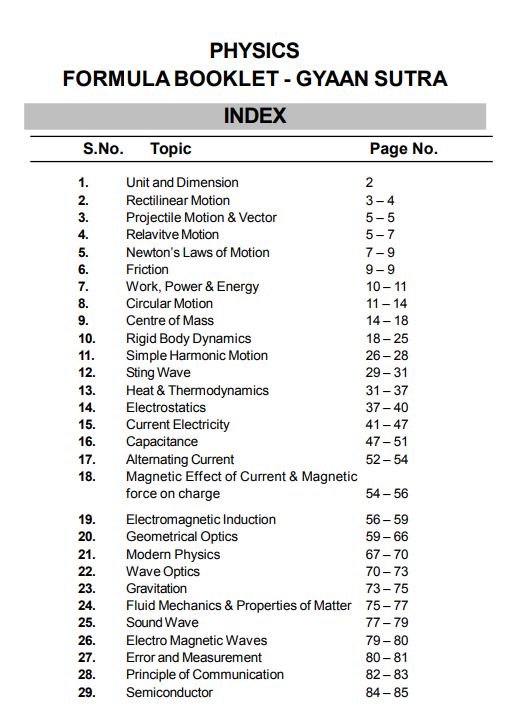
All Physics Formulas for NEET PDF – Complete Guide (Class 11 & 12): Physics plays a decisive role in NEET preparation, and mastering formulas is essential for solving numerical problems quickly and accurately. A well-organized collection of all physics formulas for NEET PDF helps streamline revision, improve speed, and strengthen conceptual clarity across Class 11 and 12 topics.
From mechanics and thermodynamics to modern physics and optics, having all formulas in one place enables efficient last-minute revision and boosts confidence during exams. This article provides a structured overview along with a table of 100 important physics formulas commonly used in NEET.
Meaning and Importance of Physics Formulas for NEET
Physics formulas are mathematical representations of physical laws and principles. In NEET, most questions are application-based, requiring quick recall and correct usage of formulas.
A consolidated physics formula PDF for competitive exams typically includes:
- Chapter-wise formulas (Class 11 & 12)
- Units and dimensions
- Important constants
- Shortcut relations for problem-solving
Such resources are especially useful for revision before mock tests and final exams.
Key Concepts Covered in NEET Physics Formulas
The formula list generally includes:
- Mechanics: Motion, laws of motion, work, energy, power
- Thermodynamics: Heat, laws, entropy
- Waves & Oscillations
- Electrostatics & Current Electricity
- Magnetism & EMI
- Optics
- Modern Physics
Understanding the concept behind each formula is crucial for correct application.
List of 100 Important Physics Formulas for NEET
| No. | Formula Name | Formula |
|---|---|---|
| 1 | Speed | v = d/t |
| 2 | Velocity | v = displacement/time |
| 3 | Acceleration | a = (v – u)/t |
| 4 | First Equation of Motion | v = u + at |
| 5 | Second Equation of Motion | s = ut + ½at² |
| 6 | Third Equation | v² = u² + 2as |
| 7 | Force | F = ma |
| 8 | Momentum | p = mv |
| 9 | Impulse | J = Ft |
| 10 | Work | W = F·d |
| 11 | Kinetic Energy | KE = ½mv² |
| 12 | Potential Energy | PE = mgh |
| 13 | Power | P = W/t |
| 14 | Gravitational Force | F = Gm₁m₂/r² |
| 15 | Gravitational Potential | V = -GM/r |
| 16 | Escape Velocity | v = √(2GM/R) |
| 17 | Pressure | P = F/A |
| 18 | Density | ρ = m/V |
| 19 | Pascal’s Law | P₁ = P₂ |
| 20 | Buoyant Force | F = ρgV |
| 21 | Hooke’s Law | F = -kx |
| 22 | Stress | σ = F/A |
| 23 | Strain | ε = ΔL/L |
| 24 | Young’s Modulus | Y = stress/strain |
| 25 | Angular Velocity | ω = θ/t |
| 26 | Centripetal Force | F = mv²/r |
| 27 | Torque | τ = rFsinθ |
| 28 | Angular Momentum | L = Iω |
| 29 | Moment of Inertia | I = Σmr² |
| 30 | Rotational KE | KE = ½Iω² |
| 31 | Heat | Q = mcΔT |
| 32 | First Law Thermodynamics | ΔQ = ΔU + W |
| 33 | Ideal Gas Equation | PV = nRT |
| 34 | Work (Gas) | W = PΔV |
| 35 | Efficiency | η = output/input |
| 36 | Wave Speed | v = fλ |
| 37 | Frequency | f = 1/T |
| 38 | SHM Force | F = -kx |
| 39 | Time Period (SHM) | T = 2π√(m/k) |
| 40 | Energy in SHM | E = ½kA² |
| 41 | Coulomb’s Law | F = kq₁q₂/r² |
| 42 | Electric Field | E = F/q |
| 43 | Potential | V = W/q |
| 44 | Capacitance | C = Q/V |
| 45 | Energy in Capacitor | U = ½CV² |
| 46 | Ohm’s Law | V = IR |
| 47 | Resistance | R = ρL/A |
| 48 | Electric Power | P = VI |
| 49 | Series Resistance | R = R₁ + R₂ |
| 50 | Parallel Resistance | 1/R = 1/R₁ + 1/R₂ |
| 51 | Magnetic Force | F = qvBsinθ |
| 52 | Lorentz Force | F = q(E + vB) |
| 53 | Magnetic Field (Wire) | B = μ₀I/2πr |
| 54 | Ampere’s Law | ∮B·dl = μ₀I |
| 55 | Faraday’s Law | E = -dΦ/dt |
| 56 | Inductance | L = Φ/I |
| 57 | Energy in Inductor | U = ½LI² |
| 58 | AC Current | I = I₀sinωt |
| 59 | RMS Voltage | V = V₀/√2 |
| 60 | Impedance | Z = √(R² + X²) |
| 61 | Snell’s Law | n₁sinθ₁ = n₂sinθ₂ |
| 62 | Refractive Index | n = c/v |
| 63 | Mirror Formula | 1/f = 1/v + 1/u |
| 64 | Lens Formula | 1/f = 1/v – 1/u |
| 65 | Magnification | m = v/u |
| 66 | Power of Lens | P = 1/f |
| 67 | Photon Energy | E = hf |
| 68 | Einstein Equation | E = mc² |
| 69 | Photoelectric Effect | KE = hf – φ |
| 70 | Bohr Radius | r = n²h²/4π²mk |
| 71 | Nuclear Density | ρ = constant |
| 72 | Radioactive Decay | N = N₀e^(-λt) |
| 73 | Half-Life | T = 0.693/λ |
| 74 | Binding Energy | E = Δmc² |
| 75 | Drift Velocity | v = eEτ/m |
| 76 | Mobility | μ = v/E |
| 77 | Current Density | J = nqv |
| 78 | Magnetic Flux | Φ = BAcosθ |
| 79 | Induced EMF | E = BLv |
| 80 | Cyclotron Frequency | f = qB/2πm |
| 81 | Wien’s Law | λT = constant |
| 82 | Stefan Law | E = σT⁴ |
| 83 | Pressure Energy | P = ½ρv² |
| 84 | Bernoulli Equation | P + ½ρv² + ρgh = constant |
| 85 | Surface Tension | T = F/L |
| 86 | Capillary Rise | h = 2Tcosθ/ρgr |
| 87 | Angular Acceleration | α = dω/dt |
| 88 | Work (Rotation) | W = τθ |
| 89 | Power (Rotation) | P = τω |
| 90 | Doppler Effect | f’ = f(v±vo)/(v±vs) |
| 91 | Electric Flux | Φ = EA |
| 92 | Gauss Law | Φ = q/ε₀ |
| 93 | Potential Energy (Charge) | U = kq₁q₂/r |
| 94 | Electric Dipole Moment | p = qd |
| 95 | Torque on Dipole | τ = pE sinθ |
| 96 | Energy Density | u = ½ε₀E² |
| 97 | Hall Effect | V = IB/ne |
| 98 | Resistance Temp Relation | R = R₀(1 + αT) |
| 99 | Phase Difference | φ = 2πx/λ |
| 100 | Wave Equation | y = A sin(kx – ωt) |
Practical Benefits of Using Physics Formula PDF
- Enables quick revision before exams
- Improves speed in numerical solving
- Helps in identifying formula-based question patterns
- Reduces dependency on textbooks during revision
- Ideal for printable A4 study charts
What’s Included in a Physics Formula PDF
A well-prepared physics all formulas PDF typically contains:
- Chapter-wise formulas (Class 11 & 12)
- Important derivations (short form)
- Units and SI conversions
- Diagrams for visualization
- Quick revision sheets
Conclusion
A structured collection of all physics formulas for NEET PDF is one of the most powerful tools for exam preparation. It simplifies revision, strengthens conceptual clarity, and enhances problem-solving speed. Consistent practice with formulas, along with conceptual understanding, ensures better performance in NEET physics.
FAQs
1. Where can all physics formulas for NEET PDF be used?
They are useful for quick revision, mock test preparation, and last-minute study before exams.
2. Are Class 11 and 12 formulas enough for NEET physics?
Yes, NEET physics is primarily based on NCERT Class 11 and 12 concepts.
3. How many formulas should be memorized for NEET?
Around 100–150 key formulas covering all chapters are sufficient for strong preparation.
4. Is a printable physics formula chart helpful?
Yes, printable A4 charts help in visual learning and quick daily revision.
5. How to remember physics formulas easily?
Regular practice, concept understanding, and writing formulas repeatedly improve retention.