List of Themes in Literature pdf free download : A List of Themes in Literature provides a structured way to understand the deeper meanings behind stories, poems, and plays. Themes represent the central ideas that authors explore—such as love, courage, identity, or conflict—and they help readers connect emotionally and intellectually with a text. For students, teachers, and writers, having a well-organized list of themes in literature PDF is an essential learning and teaching resource.
A comprehensive list typically includes both universal themes found across cultures and specific themes tailored for educational levels, including middle school and children’s literature. These lists are widely used in classrooms, writing workshops, and literary analysis exercises.
Meaning of Themes in Literature
In literature, a theme is the underlying message or insight about life that a story conveys. It is not the plot or the events themselves, but the meaning behind those events.
For example:
- A story about a hero’s journey may explore the theme of courage
- A tale of friendship may highlight loyalty and trust
- A tragic narrative may reflect loss, fate, or human weakness
Themes are often universal, meaning they apply to real-life experiences and emotions across different cultures and time periods.
Common Themes in Literature
A well-prepared list of common themes in literature includes a wide range of recurring ideas. These are frequently studied in schools and appear in both classic and modern works.
Some widely recognized themes include:
- Love and relationships
- Good vs evil
- Courage and bravery
- Friendship and loyalty
- Identity and self-discovery
- Power and corruption
- Justice and injustice
- Life and death
- Freedom and oppression
- Coming of age
These themes form the foundation of literary analysis and are especially useful for middle school and high school students.
List of Themes in Literature for Students
Educational resources often categorize themes based on age groups and reading levels. A common themes in literature middle school PDF typically includes simplified and relatable themes such as:
- Overcoming challenges
- Importance of honesty
- Standing up for what is right
- Family and belonging
- Acceptance and diversity
For younger learners, a list of common themes in children’s literature PDF focuses on clear moral lessons:
- Kindness and empathy
- Sharing and cooperation
- Respect for others
- Imagination and creativity
- Learning from mistakes
These categorized lists help students better understand stories and improve their analytical thinking.
List of Common Themes – Literary Devices Perspective
From a literary devices standpoint, themes are closely connected to elements such as symbolism, motifs, and tone. A structured List of Common Themes – Literary Devices often groups themes into broader categories:
- Human Nature: greed, ambition, fear
- Society and Culture: tradition, class struggle, social justice
- Moral Lessons: honesty, integrity, responsibility
- Emotional Experiences: love, grief, happiness
- Philosophical Ideas: fate vs free will, meaning of life
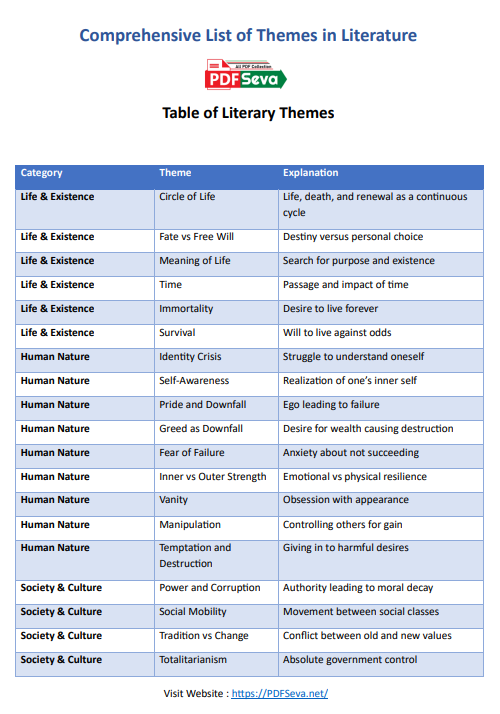
| Category | Theme | Description |
|---|---|---|
| Human Nature | Love | Emotional connection, affection, and relationships |
| Human Nature | Hate | Intense dislike, conflict, and emotional struggle |
| Human Nature | Courage | Facing fear, bravery in difficult situations |
| Human Nature | Fear | Anxiety, survival instincts, internal conflict |
| Human Nature | Identity | Self-discovery and personal understanding |
| Human Nature | Growth | Personal development and maturity |
| Human Nature | Ambition | Desire for success, power, or achievement |
| Human Nature | Jealousy | Envy and insecurity in relationships |
| Human Nature | Pride | Self-respect or excessive ego |
| Human Nature | Guilt | Feeling of responsibility for wrongdoing |
| Society | Justice | Fairness, law, and moral rightness |
| Society | Injustice | Inequality, unfair treatment |
| Society | Power | Authority, control, and influence |
| Society | Corruption | Abuse of power or moral decay |
| Society | Freedom | Independence and personal rights |
| Society | Oppression | Control and suppression by authority |
| Society | Tradition | Cultural beliefs and customs |
| Society | Change | Social or personal transformation |
| Society | Class Struggle | Conflict between social or economic groups |
| Society | War | Conflict between nations or groups |
| Relationships | Friendship | Trust, loyalty, and companionship |
| Relationships | Family | Bonds, responsibilities, and support systems |
| Relationships | Betrayal | Breaking trust in relationships |
| Relationships | Loyalty | Faithfulness and commitment |
| Relationships | Sacrifice | Giving up something for others |
| Relationships | Love vs Duty | Conflict between emotion and responsibility |
| Moral Themes | Honesty | Truthfulness and integrity |
| Moral Themes | Deception | Lies and manipulation |
| Moral Themes | Good vs Evil | Moral conflict between right and wrong |
| Moral Themes | Responsibility | Accountability for actions |
| Moral Themes | Forgiveness | Letting go of anger or resentment |
| Life Concepts | Life and Death | Mortality and meaning of life |
| Life Concepts | Fate vs Free Will | Destiny versus personal choice |
| Life Concepts | Time | Passage of time and its effects |
| Life Concepts | Change and Transformation | Growth through experiences |
| Life Concepts | Survival | Overcoming life-threatening challenges |
| Emotional Themes | Happiness | Joy and fulfillment |
| Emotional Themes | Grief | Loss and sorrow |
| Emotional Themes | Loneliness | Isolation and emotional emptiness |
| Emotional Themes | Hope | Optimism and belief in a better future |
| Emotional Themes | Despair | Loss of hope |
| Philosophical | Meaning of Life | Purpose and existence |
| Philosophical | Reality vs Illusion | Truth versus perception |
| Philosophical | Knowledge vs Ignorance | Awareness and understanding |
| Philosophical | Human Condition | Nature of human existence |
| Children’s Literature | Kindness | Helping and caring for others |
| Children’s Literature | Sharing | Cooperation and generosity |
| Children’s Literature | Respect | Valuing others and differences |
| Children’s Literature | Imagination | Creativity and fantasy |
| Children’s Literature | Learning Lessons | Moral development |
| Middle School | Overcoming Obstacles | Facing and solving problems |
| Middle School | Standing Up for Right | Moral courage |
| Middle School | Peer Pressure | Influence of others |
| Middle School | Self-Confidence | Belief in oneself |
| Middle School | Acceptance | Embracing differences |
Understanding these categories helps readers go beyond surface-level reading and engage in deeper literary interpretation.
Practical Uses of a Themes in Literature PDF
A downloadable list of themes in literature PDF free download is a valuable resource in both academic and creative contexts.
It is commonly used for:
- Classroom teaching: Teachers use theme lists to design lessons and assignments
- Student learning: Helps identify themes while reading or writing essays
- Creative writing: Writers use theme lists to develop meaningful stories
- Exam preparation: Useful for literature exams and comprehension tests
- Worksheet creation: Ideal for printable educational materials
For educators creating worksheets or curriculum content, a structured theme list can significantly improve lesson planning and student engagement.
What’s Included in a Typical Themes PDF
A high-quality List of Possible Themes in Literary Works PDF usually contains:
- Alphabetical or categorized theme lists
- Definitions and brief explanations
- Examples from literature
- Age-specific theme groups (children, middle school, advanced)
- Printable format for classroom use
Such PDFs are designed to be easy to read, print, and integrate into teaching materials.
Conclusion
A well-organized List of Themes in Literature is more than just a reference—it is a powerful tool for understanding storytelling at a deeper level. Whether used in classrooms, writing projects, or independent study, it enhances critical thinking and strengthens literary analysis skills. Access to a clear and structured PDF version makes it even more practical for everyday use.
FAQs
1. What is a theme in literature?
A theme is the central idea or underlying message that a literary work conveys about life, human nature, or society.
2. Why is a list of themes in literature important?
It helps students and readers identify deeper meanings in texts and improves analytical and writing skills.
3. What are the most common themes in literature?
Common themes include love, conflict, identity, courage, friendship, power, and justice.
4. Is there a printable list of themes in literature PDF?
Yes, many educational resources offer printable PDFs that include categorized and easy-to-understand theme lists.
5. How do themes help in writing essays?
Themes provide a clear focus for analysis, helping writers explain the deeper meaning of a story with strong arguments.