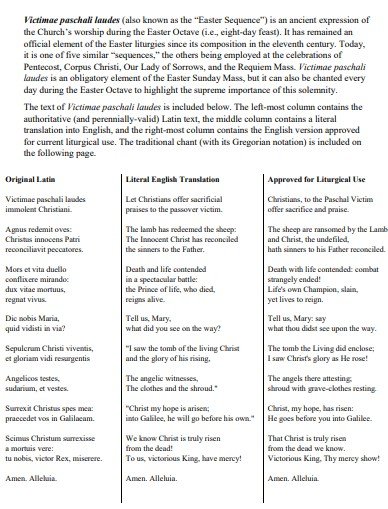
“Victimae Paschali Laudes” is an ancient, powerful hymn sung during the Christian celebration of Easter. The title roughly translates to “Praise to the Paschal Victim.” It is used to celebrate the joy and mystery of Jesus Christ’s resurrection.
Where Did It Come From?
The hymn was written back in the 11th century, and historians believe it was composed by Wipo of Burgundy, a chaplain for the Holy Roman Emperor. In the early days of the church, there were many of these special chants (called “sequences”) sung during services. Over the centuries, the church removed most of them, but “Victimae Paschali Laudes” is one of the rare few that is still officially used today.
The Story It Tells
The hymn is written like a poetic conversation that walks worshippers through the Easter story. It focuses on four main themes:
- The Invitation: Calling on Christians to offer their praise.
- The Sacrifice: Reflecting on Christ giving His life to save humanity.
- The Battle: Describing the epic clash between life and death, where life ultimately wins.
- The Witness: Featuring a dialogue with Mary Magdalene, highlighting her vital role as the person who witnessed the empty tomb and the risen Christ.
Victimae Paschali Laudes pdf
Here is a look at a few of the most famous lines from the hymn and what they mean:
| Original Latin | English Translation |
|---|---|
| Victimae paschali laudes immolent Christiani | Christians, offer sacrifices of praise to the Paschal Victim |
| Mors et vita duello conflixere mirando | Death and life have contended in a spectacular battle |
| Surrexit Christus spes mea | Christ my hope has risen |
How It Sounds
If you hear this in a traditional church, it is usually sung as a “Gregorian chant.” This musical style has a single, unified melody without backing instruments and flows with a free rhythm rather than a strict, modern beat. This creates a deeply peaceful and sacred atmosphere. However, it is also frequently adapted for modern choirs.
Why People Still Use It Today
- A Bridge to the Past: Singing it connects modern believers to a thousand years of Christian history and tradition.
- The Core Message: It perfectly captures the foundational Easter message of sacrifice, hope, and redemption.
- Versatility: Beyond Sunday church services, it is often used for quiet personal prayer, religious reflection, or as an educational tool to teach children about church history and the Latin language.