trust amendment form pdf free download- Making changes to your trust doesn’t mean starting from scratch. Life evolves — families grow, assets change, relationships shift — and your estate plan should keep pace. That’s where a Trust Amendment Form becomes essential.
If you’re looking for a Trust Amendment Form PDF free download, you’re in the right place. This guide explains what it is, when to use it, and how to complete it properly — plus what to keep in mind before signing.
What Is a Trust Amendment Form?
A Trust Amendment Form is a legal document used to modify specific provisions of an existing trust without rewriting the entire trust agreement.
Instead of revoking the original trust, you simply update certain sections. The amendment becomes legally attached to the original trust document and should be stored with it.
This form is commonly used with revocable living trusts, where the grantor retains the right to make changes during their lifetime.
When Do You Need a Trust Amendment?
You may need to amend your trust if:
- You want to change beneficiaries
- You need to add or remove a trustee
- You’re updating asset distribution terms
- A beneficiary has passed away
- You’ve divorced or remarried
- You’ve moved to another state
- Tax laws have changed
Small updates are best handled through an amendment. However, if you’re making extensive changes, it may be better to restate or revoke and recreate the trust.
What’s Included in the Trust Amendment Form PDF?
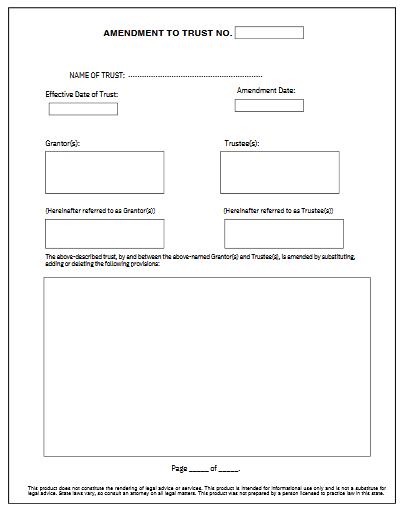
The downloadable PDF typically contains the following sections:
1. Trust Identification Details
- Name of the trust
- Effective date of the original trust
- Trust number (if applicable)
- Names of Grantor(s)
- Names of Trustee(s)
2. Amendment Clause
A clearly written section stating that the original trust is being amended by:
- Substituting
- Adding
- Deleting
specific provisions.
3. Incorporation Clause
A statement confirming that all other provisions of the original trust remain unchanged and in full effect.
4. Signatures
- Grantor(s) signature
- Trustee(s) signature
- Witness signatures
5. Notary Section
A formal acknowledgment section for notarization, including:
- State and County
- Notary signature
- Seal
Important Legal Disclaimer
The form includes a standard notice stating that it:
- Does not constitute legal advice
- Is for informational purposes only
- May vary based on state laws
- Should be reviewed by an attorney before execution
Estate planning laws differ significantly between states, so it’s wise to consult a qualified attorney, especially if large assets or complex family structures are involved.
How to Fill Out the Trust Amendment Form (Step-by-Step)
Here’s how to complete the form correctly:
Step 1: Enter Trust Details
Fill in:
- Name of the original trust
- Date the trust was created
- Names of grantor(s) and trustee(s)
Ensure these match the original trust document exactly.
Step 2: Specify the Amendment Date
Enter the date you are making the amendment.
Step 3: Clearly Describe the Changes
Be precise. For example:
Instead of writing:
“Change beneficiary.”
Write:
“Article IV, Section 2 is hereby amended to replace John Smith with Sarah Smith as primary beneficiary.”
Clarity prevents disputes later.
Step 4: Sign the Document
The grantor must sign. Depending on your state:
- Witness signatures may be required
- Notarization is typically recommended
Step 5: Attach to Original Trust
Do not separate the amendment from the original trust. Store them together in a secure location.
Trust Amendment vs. Trust Restatement
Many people confuse these two.
Trust Amendment
- Modifies specific sections
- Keeps original trust intact
- Best for small changes
Trust Restatement
- Rewrites the entire trust
- Keeps the original trust name and date
- Best for major changes
If you’re updating multiple provisions, a restatement may be cleaner and legally safer.
Does a Trust Amendment Need to Be Notarized?
In most states, notarization is strongly recommended and often required to:
- Prevent fraud
- Strengthen enforceability
- Ensure acceptance by financial institutions
Check your state’s requirements before signing.
Common Mistakes to Avoid
- Using incorrect trust name or date
- Making vague or unclear amendments
- Forgetting witness or notary requirements
- Failing to attach amendment to original trust
- Creating multiple conflicting amendments
If you’ve made several amendments over time, consider consolidating them into a restatement.
Is This Form Valid in All States?
The template is designed for general use, but estate laws vary by state. Requirements for:
- Witnesses
- Notarization
- Formatting
- Trust validity
can differ significantly.
Always verify compliance with your local state law before execution.
Who Can Amend a Trust?
Typically:
- Only the Grantor of a revocable trust can amend it.
- Irrevocable trusts generally cannot be amended without court approval or beneficiary consent.
If the grantor has passed away, the trust usually becomes irrevocable and cannot be changed.
Why Keeping Your Trust Updated Matters
An outdated trust can:
- Leave out new family members
- Cause inheritance disputes
- Create tax inefficiencies
- Lead to unintended asset distribution
Regularly reviewing your trust — especially after major life events — ensures your wishes are honored.
Trust Amendment Form PDF Free Download
You can download the Trust Amendment Form PDF and print it for use. Before signing:
Review your original trust carefully
Make precise and clear amendments
Check your state’s legal requirements
Consider legal review if assets are substantial
This form is ideal for individuals who need a simple, structured way to update their trust without drafting an entirely new document.
A trust amendment is not complicated — but it must be done correctly. One unclear sentence can create confusion for years.
Take your time. Review everything twice. And when in doubt, consult a professional.
If you’re ready to update your estate plan, download the Trust Amendment Form PDF and make your changes with confidence.