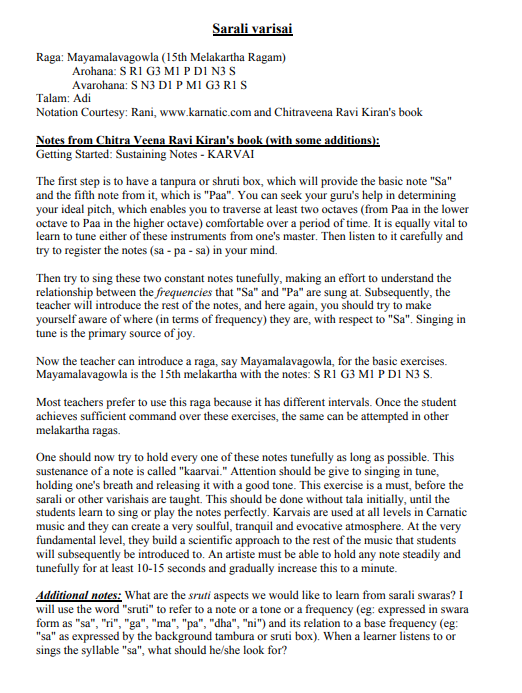
Sarali Varisai pdf free download : Are you beginning your journey in Carnatic music for beginners? The very first and most important step is learning Sarali Varisai. These basic exercises build a strong musical foundation for students, teachers, and music lovers.
In this post, you will get a complete guide to Sarali Varisai notations, its importance, and a free Sarali Varisai PDF download to help you practice anytime, even offline.
What is Sarali Varisai?
Sarali Varisai means “simple sequences” and is the first lesson in Carnatic music. It consists of structured swara (note) patterns that help learners understand:
- Basic Swaras (Sa, Ri, Ga, Ma, Pa, Da, Ni)
- Tala (rhythm)
- Sruti (pitch accuracy)
These exercises are usually taught in the Mayamalavagowla Ragam, which is considered ideal for beginners due to its balanced and systematic scale.
Why is Sarali Varisai Important?
Strong Musical Foundation
Helps students recognize and practice all seven swaras clearly.
Improves Voice & Clarity
Daily practice enhances voice control and tonal stability.
Better Rhythm Control
Most exercises are set in Adi Talam (8 beats), helping learners master timing.
Speed & Flexibility
Practiced in three speeds (Kalas), improving vocal or instrumental agility.
Sarali Varisai Exercises Overview
The complete Sarali Varisai PDF includes 14 structured sequences, each designed to improve specific skills:
- Sequence 1: Basic ascending and descending notes
- Middle Sequences: Pattern variations for better swara control
- Sequence 14: Advanced combination preparing for Jantai Varisai
Following is the Notation of the Swarams
s = sa ; r = ri ; g = ga ; m = ma ; p = pa; d = dha ; n = ni ; Any Capital letters such as ‘S’ are in the higher octave
Listen to all the 14 Sarali Varisai playlist. It is sung in Mayamalavagowla ragam at a slow speed so that students can learn by listening and singing along.
Sarili Varisai 1 – Simple ascent/descent
Laya pattern: 1234 5678
s r g m | p d | n S ||
S n d p | m g | r s ||
Sarili Varisai 2 – Focus on R and N
Laya pattern: 12-12-1234 and 1234 5678
s r s r | s r | g m ||s r g m | p d | n S ||
S n S n | S n | d p ||S n d p | m g | r s ||
Sarili Varisai 3 – Focus on G and D.
Laya pattern: 123-123-12 and 1234 5678
s r g s | r g | s r || s r g m | p d | n S ||
S n d S | n d | S n ||S n d p | m g | r s ||
Sarili Varisai 4 – Focus on M and P
Laya pattern: 1234-1234 and 1234 5678
s r g m | s r | g m || s r g m | p d | n s ||
S n d p | S n | d p || S n d p | m g | r s ||
Sarali Varisai 5 – Focus on P and M (dheergam); and R, N
Laya pattern: 1234 56-12 and 1234 5678
s r g m | p , | s r || s r g m | p d | n S ||
S n d p | m , | S n || S n d p | m g | r s ||
Sarali Varisai 6 – Focus on G and D
Laya pattern: 1234 56-12 and 1234 5678
s r g m | p d | s r ||s r g m | p d | n S ||
S n d p | m g | S n ||S n d p | m g | r s ||
Sarali Varisai 7 – Focus on N and R (dheergam)
Laya pattern: 1234 56-7, and 1234 5678
s r g m | p d | n , || s r g m | p d | n S ||
S n d p | m g | r , || S n d p | m g | r s ||
Sarali Varisai 8 – Zig Zag with Focus on “pmgr” and “mpdn”
Laya pattern: 1234 -4321 and 1234 5678
s r g m | p m | g r || s r g m | p d | n S ||
S n d p | m p | d n ||S n d p | m g | r s ||
Sarali Varisai 9 – Zig Zag with Focus on “pmdp” and “mpgm”
Laya pattern: 1234 -4321 and 1234 5678
s r g m | p m | d p || s r g m | p d | n S ||
S n d p | m p | g m ||S n d p | m g | r s ||
Sarali Varisai 10 – Focus on P (dheergam) and the region between G and N and practicing resting on G (nyaasa swaram)
Laya pattern: 1234 56-12 and 1 , , , 1 , , , and
1234 – 4321 and 1234 5678
s r g m | p , | g m || p , , , | p , | , , ||
g m p d | n d | p m || g m p – g | m g | r s ||
Sarali Varisai 11 – Focus on dheergams at S, N, D, P.
Simple patterns: “Snd”, “Ndp”, “Dpm” and the region between G and N (finishing phrases)
S , n d | n , | d p || d , p m | p , | p , ||
g m p d | n d | p m || g m p g | m g | r s ||
Sarali Varisai 12 – Preview of Janta (sphuritam) concept: “SS”, “nn”, “dd”, “pp”.
Simple patterns: “SSnd”, “nndp”, “ddpm” Dheergam at “paa” and the region between G and N (finishing phrases)
S S n d | n n | d p || d d p m | p , | p , ||
g m p d | n d | p m || g m p g | m g | r s ||
Sarali Varisai 13 – ZigZag Patterns: “srgr G”, “gmpmP”,
Dheergam Focus: G, P, D and the region between M and N (with a lot of emphasis on zigzag and D-notes)
s r g r | g , | g m || p m p , | d p | d , ||
m p d p | d n | d p || m p d p | m g | r s ||
Sarali Varisai 14 – Dheergam at P and S. Jantas at D and M
s r g m | p , | p , || d d p , | m m | p , ||
d n S , | S n | d p ||S n d p | m g | r s ||
In the class, you will be taught to sing the above at 1st, 2nd, 3rd and 4th Speed
Sarali Varishai in four speeds:
First speed – One note per beat/unit
1 | 2 | 3 | 4 | 5 | 6 | 7 | 8 |
s r g m p d n S
Second speed – two notes per beat/unit
1 | 2 | 3 | 4 | 5 | 6 | 7 | 8 |
sr gm pd nS Sn dp mg rs
Third speed – four notes per unit
1 | 2 | 3 | 4 | 5 | 6 | 7 | 8 |
srgm pdnS Sndp mgrs srgm pdnS Sndp mgrs
Fourth speed – eight notes per unit
1 | 2 | 3 | 4 |
srgmpdnS Sndpmgrs srgmpdnS Sndpmgrs
5 | 6 | 7 | 8 |
srgmpdnS Sndpmgrs srgmpdnS Sndpmgrs
Tips to Practice Sarali Varisai Effectively
- Use Tanpura: Maintain correct pitch with a steady drone
- Sit Properly: Good posture improves breathing and voice control
- Start Slow: Focus on accuracy before increasing speed
- Follow Talam: Use hand gestures to keep rhythm correctly
Sarali Varisai is the gateway to mastering Carnatic music basics. With consistent practice, it builds the foundation needed for advanced lessons like ragas and kritis.
Download the Sarali Varisai PDF today and start your musical journey with confidence!
Download Sarali Varisai PDF
We have compiled all 14 Sarali Varisai exercises with clear swara notations and tala markings into an easy-to-use printable format.
Click Here to Download Sarali Varisai PDF (Free)