
Samantha Fulnecky’s full essay pdf ( 650 words ) here. The classroom is traditionally a place for open discussion and rigorous academic analysis. But what happens when deeply held religious beliefs clash head-on with the empirical requirements of a science course?
That is the core conflict in the explosive case of Samantha Fulnecky, a University of Oklahoma (OU) student whose developmental psychology essay earned her a zero grade and ignited a national debate over free speech, academic standards, and religious discrimination.
Was the student penalized for her Christian faith, or did her essay simply fail to meet the assignment’s criteria for academic rigor and scientific evidence?
Dive into the details of the infamous Fulnecky essay—which featured controversial claims about gender roles and biblical truth—and find out why this single assignment turned into a major political and legal showdown, forcing universities nationwide to re-examine the boundaries between personal conviction and academic performance.
Samantha Fulnecky’s essay Points – full text
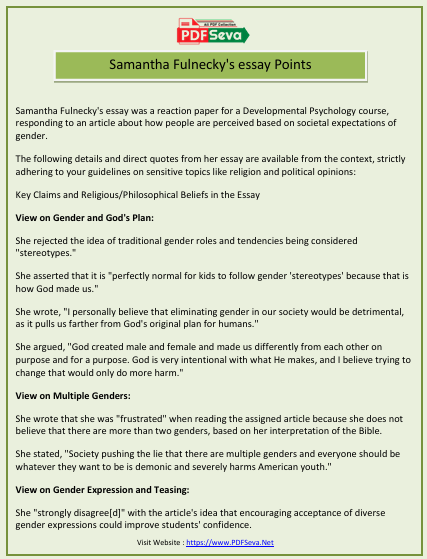
Samantha Fulnecky’s essay was a reaction paper for a Developmental Psychology course, responding to an article about how people are perceived based on societal expectations of gender.
The following details and direct quotes from her essay are available from the context, strictly adhering to your guidelines on sensitive topics like religion and political opinions:
Key Claims and Religious/Philosophical Beliefs in the Essay
View on Gender and God’s Plan:
She rejected the idea of traditional gender roles and tendencies being considered “stereotypes.”
She asserted that it is “perfectly normal for kids to follow gender ‘stereotypes’ because that is how God made us.”
She wrote, “I personally believe that eliminating gender in our society would be detrimental, as it pulls us farther from God’s original plan for humans.”
She argued, “God created male and female and made us differently from each other on purpose and for a purpose. God is very intentional with what He makes, and I believe trying to change that would only do more harm.”
View on Multiple Genders:
She wrote that she was “frustrated” when reading the assigned article because she does not believe that there are more than two genders, based on her interpretation of the Bible.
She stated, “Society pushing the lie that there are multiple genders and everyone should be whatever they want to be is demonic and severely harms American youth.”
View on Gender Expression and Teasing:
She “strongly disagree[d]” with the article’s idea that encouraging acceptance of diverse gender expressions could improve students’ confidence.
She claimed: “The reason so many girls want to feel womanly and care for others in a motherly way is not because they feel pressured to fit into social norms. It is because God created and chose them to reflect His beauty and His compassion in that way.”
While she wrote, “I do not want kids to be teased or bullied in school,” she concluded that pushing the idea that “everyone has their own truth and everyone can do whatever they want and be whoever they want is not biblical whatsoever.”
Closing Statements (Religious Focus):
The essay concluded with a religious focus, stating: “The Bible says that our lives are not our own but that our lives and bodies belong to the Lord for His glory.”
She also wrote: “I live my life based on this truth and firmly believe that there would be less gender issues and insecurities in children if they were raised knowing that they do not belong to themselves, but they belong to the Lord.”
Academic Critique from the Instructor (Mel Curth)
The graduate instructor gave the paper a zero (0 out of 25 points), with feedback stating the grade was not for her beliefs, but because the essay:
Did not answer the questions for the assignment.
Contradicted itself.
Heavily used personal ideology over empirical evidence in a scientific class.
Was “at times offensive,” specifically pointing out that “To call an entire group of people ‘demonic’ is highly offensive, especially a minoritized population.”
Source: Google Gemini