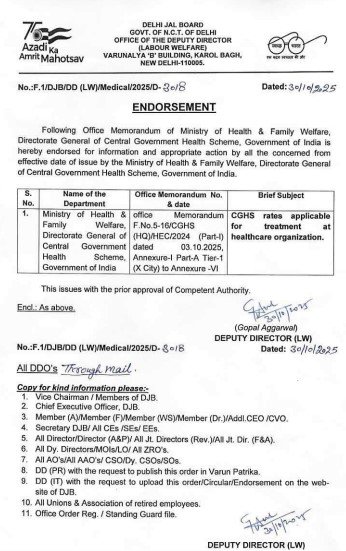
The Revised CGHS Rate List 2025 pdf is a very important update for all Central Government employees and pensioners. Issued by the government, this document sets the standard prices for medical treatments, ensuring that hospitals do not overcharge patients.
What Is This List?
This is the official price list for all medical services under the Central Government Health Scheme (CGHS). It applies to private hospitals, government hospitals, and diagnostic labs that are partnered with CGHS.
The list covers the costs for:
- Hospital stays (Room rent).
- Surgeries and medical procedures.
- Lab tests and scans (X-rays, MRIs).
- Doctor consultations.
When Did It Start?
These new rates became effective on October 13, 2025.
- Any old price lists are no longer valid.
- Hospitals must charge according to these new rules.
Who Does It Apply To?
This list applies to:
- Current Central Government employees.
- Pensioners.
- Freedom fighters, MPs, and Judges covered by CGHS.
- Family members dependent on the main cardholder.
How Are Rates Calculated?
The cost of treatment depends on three things: the city you live in, the type of hospital you choose, and the type of room you are eligible for.
1. City Categories
- Tier-I (X Cities): These are major metro areas like Delhi, Mumbai, Chennai, Kolkata, Bengaluru, and Hyderabad. These cities have the standard base rates.
- Tier-II (Y Cities): Rates here are 10% lower than in Tier-I cities.
- Tier-III (Z Cities): Rates here are 20% lower than in Tier-I cities.
2. Room/Ward Categories The prices are set based on a “Semi-Private Ward.”
- General Ward: You pay 5% less than the standard rate.
- Semi-Private Ward: You pay the standard base rate.
- Private Ward: You pay 5% more than the standard rate.
3. Hospital Quality (Accreditation)
- NABH Accredited Hospitals: These are hospitals with high-quality standards. They charge the standard rates.
- Non-NABH Hospitals: These hospitals must charge 15% less than the standard rate.
- Super-Speciality Hospitals: These hospitals can charge 15% more than the standard rate.
Rules for Multiple Surgeries
If a patient undergoes more than one surgery during the same operation session, the government does not pay the full price for all of them.
- First Surgery: Paid at 100% of the cost.
- Second Surgery: Paid at 50% of the cost.
- Third Surgery (and others): Paid at 25% of the cost.
Tests and Scans
- Lab Tests: Prices for blood tests, kidney tests, thyroid profiles, etc., are fixed based on the city and hospital type.
- Radiology (X-Ray, MRI, CT Scan): These prices are fixed for everyone. It does not matter if you are in a General Ward or a Private Ward; the cost for the scan remains the same.
Cashless Treatment and Reimbursement
- Pensioners: Usually get cashless treatment at partnered hospitals.
- Non-Empanelled Hospitals: If you go to a hospital that is not on the CGHS list (in an emergency), the government will only reimburse you based on the lowest rates (Non-NABH rates). You may have to pay the difference yourself.
Why Is This Important?
This update is crucial because it stops hospitals from overcharging government employees. It ensures that medical bills are transparent and that reimbursements are processed fairly based on clear rules.