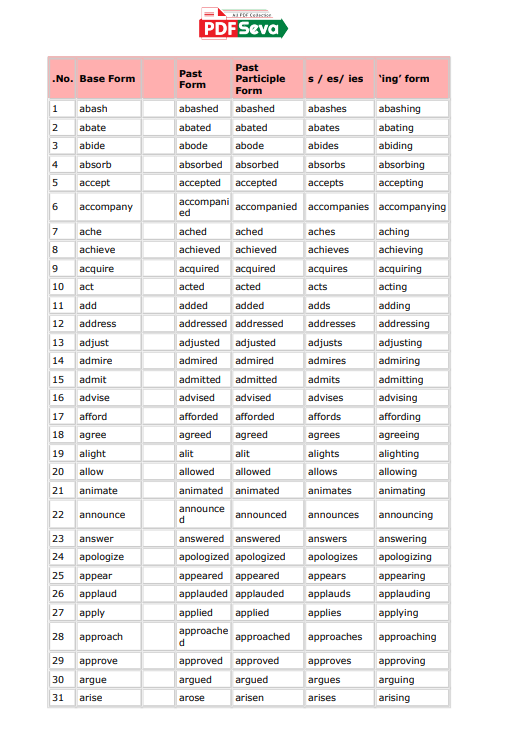
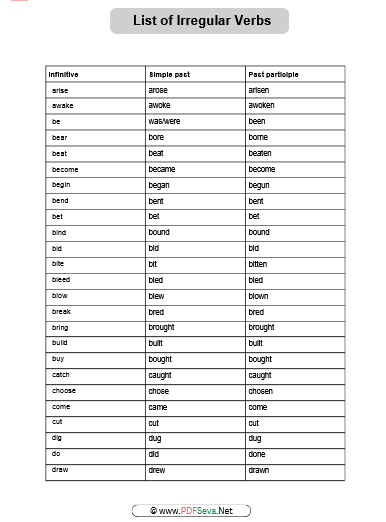
Learning English grammar becomes much easier when you master irregular verbs. Whether you’re a school student, preparing for competitive exams, or improving your spoken English, having a reliable irregular verbs list PDF can save you hours of confusion.
Unlike regular verbs that simply add -ed in the past tense, irregular verbs follow no fixed pattern. That’s why students often struggle with forms like go – went – gone or take – took – taken.
In this detailed guide, you’ll get a free downloadable irregular verbs list PDF, understand how to use it effectively, and learn practical tips to remember irregular verb forms effortlessly.
Quick Overview
- Primary Keyword: irregular verbs list pdf
- Covers 3 forms: base form, past tense, past participle
- Useful for school exams, IELTS, TOEFL, SSC, banking exams
- Includes meanings and example sentences
- Printable and classroom-friendly format
- Ideal for daily English speaking practice
What Are Irregular Verbs?
Irregular verbs are verbs that do not follow the regular pattern of adding -ed in the past tense and past participle.
For example:
- Regular verb: walk – walked – walked
- Irregular verb: write – wrote – written
There is no single rule that governs all irregular verbs. That’s why memorizing them through a structured irregular verbs list PDF download is one of the smartest strategies.
Why You Need an Irregular Verbs List PDF
Many students search for a printable list because:
- It helps in quick revision.
- It improves writing accuracy.
- It boosts confidence in spoken English.
- It prevents grammatical mistakes in exams.
- It saves time during last-minute preparation.
Imagine writing an exam and confusing “begin – began – begun” with “begined”. A small mistake can cost marks. A well-organized PDF acts like a ready reference guide.
Structure of the Irregular Verbs List PDF
A good irregular verbs list PDF usually includes:
1. Base Form (V1)
The original form of the verb.
Example: eat, go, see
2. Past Tense (V2)
Used for actions completed in the past.
Example: ate, went, saw
3. Past Participle (V3)
Used with helping verbs like has, have, had.
Example: eaten, gone, seen
4. Meaning
Simple meaning for better understanding.
5. Example Sentence
Practical sentence usage.
Sample Irregular Verbs List
Here’s a small preview:
| Base Form | Past Tense | Past Participle |
|---|---|---|
| Be | Was/Were | Been |
| Begin | Began | Begun |
| Break | Broke | Broken |
| Choose | Chose | Chosen |
| Come | Came | Come |
| Do | Did | Done |
| Drink | Drank | Drunk |
| Drive | Drove | Driven |
| Eat | Ate | Eaten |
| Go | Went | Gone |
The full irregular verbs list PDF contains 100+ commonly used verbs arranged alphabetically for easy learning.
Who Should Download This PDF?
This irregular verbs list PDF is ideal for:
- School students (Class 5–12)
- English medium learners
- Competitive exam aspirants
- IELTS & TOEFL candidates
- Teachers and tutors
- Spoken English learners
If you’re building strong grammar fundamentals, this PDF is essential.
How to Use the Irregular Verbs List Effectively
Downloading the PDF is only the first step. Here’s how to actually master irregular verbs:
1. Practice 10 Verbs Daily
Don’t try to memorize 100 verbs in one day. Divide them into small groups.
2. Make Sentences
Instead of rote memorization, create real-life sentences:
- I wrote a letter yesterday.
- She has written three emails.
3. Group Similar Patterns
Some verbs follow similar patterns:
- Sing – Sang – Sung
- Ring – Rang – Rung
Grouping makes memorization easier.
4. Use Flashcards
Write V1 on one side and V2/V3 on the other.
5. Revise Weekly
Consistency matters more than speed.
Common Mistakes Students Make
Many learners:
- Add “-ed” to irregular verbs (buyed ❌ instead of bought ✅)
- Confuse past tense and past participle
- Forget to use helping verbs correctly
- Use incorrect pronunciation
That’s why a structured irregular verbs PDF list becomes extremely helpful.
Benefits of Learning Irregular Verbs Properly
Mastering irregular verbs improves:
- Grammar accuracy
- Writing clarity
- Spoken English fluency
- Confidence in interviews
- Academic performance
You’ll notice smoother sentence construction in essays, emails, and conversations.
Tips to Memorize Irregular Verbs Faster
Here are some practical memory techniques:
Use Rhyming Patterns
- Blow – Blew – Blown
- Grow – Grew – Grown
Create Stories
Make small stories using 5–6 irregular verbs.
Practice Through Conversations
Instead of saying, “I go yesterday,” say, “I went yesterday.”
Listen to Native Content
Movies, podcasts, and English songs reinforce correct usage.
Printable & Classroom-Friendly Format
The irregular verbs list PDF download is designed for:
- A4 size printing
- Clear table format
- Easy-to-read fonts
- Alphabetical arrangement
- Black-and-white print compatibility
Teachers can use it for classroom distribution. Students can keep it in their grammar notebook.
Irregular Verbs for Competitive Exams
Most competitive exams test grammar through:
- Error detection
- Fill in the blanks
- Sentence correction
- Cloze tests
Knowing correct verb forms can significantly improve your English section score.
For example:
“She has ___ the work.”
Correct answer: done
Without knowing irregular forms, such questions become tricky.
Difference Between Regular and Irregular Verbs
| Regular Verbs | Irregular Verbs |
|---|---|
| Follow fixed rule | No fixed rule |
| Add -ed | Change completely |
| Example: play – played | Example: take – took |
Understanding this difference is fundamental for grammar mastery.
How Many Irregular Verbs Are There?
There are around 200 commonly recognized irregular verbs in English. However, about 100 are frequently used in daily communication.
That’s why most irregular verbs list PDF files focus on the most practical verbs.
There are about 200 irregular verbs in English, but around 100 are commonly used in daily conversation and exams.
Practice small groups daily, create example sentences, use flashcards, and revise weekly. Grouping similar patterns also helps.
Yes. It is useful for school exams, IELTS, TOEFL, SSC, banking, and other competitive exams.