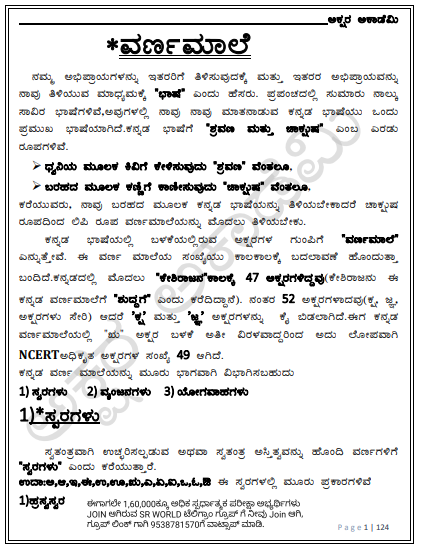
Are you starting your journey to learn Kannada? The first step to mastering any language is its script and structure. In Kannada, the group of letters we use is called the Varnamale. While it has evolved over centuries—from 47 letters during Keshiraja’s time to 52 later on—the official count followed by NCERT today is 49 letters.
Kannada Vyakarana (ಕನ್ನಡ ವ್ಯಾಕರಣ) is the backbone of the language. For students preparing for school exams, competitive exams like KPSC, FDA, SDA, or those looking for grammar basics, a structured Kannada Vyakarana PDF is an invaluable resource. This guide breaks down complex concepts into simple, systematic sections.
1. Kannada Varnamale (ಕನ್ನಡ ವರ್ಣಮಾಲೆ)
The Kannada alphabet consists of 49 letters. These are the building blocks of the language and are divided into three primary pillars. Understanding these is essential for mastering the “Shravana” (audio/hearing) and “Chakshusha” (visual/sight) forms of the language.
A. Swaragalu (Vowels – 13)
Swaras are sounds that are pronounced independently. They are classified into three types based on the time taken to pronounce them (Matra):
- Hraswa Swara (ಹ್ರಸ್ವ ಸ್ವರ): Short vowels pronounced in one ‘matra’ (e.g., ಅ, ಇ, ಉ, ಋ, ಎ, ಒ).
- Deergha Swara (ದೀರ್ಘ ಸ್ವರ): Long vowels pronounced in two ‘matras’ (e.g., ಆ, ಈ, ಊ, ಏ, ಐ, ಓ, ಔ).
- Plutha Swara (ಪ್ಲುತ ಸ್ವರ): Prolonged vowels used for emotional emphasis or calling someone from a distance (e.g., ಅಮ್ಮಾS!).
B. Vyanjanagalu (Consonants – 34)
Consonants require the help of vowels to be fully pronounced. They are split into:
- Vargiya Vyanjana (ವರ್ಗೀಯ ವ್ಯಂಜನ – 25): These are classified into five groups (K-Varga, Cha-Varga, etc.) based on where the sound originates—such as Guttural (ಕಂಠ್ಯ), Palatal (ತಾಲವ್ಯ), Cerebral (ಮೂರ್ಧನ್ಯ), Dental (ದಂತ್ಯ), and Labial (ಓಷ್ಟ್ಯ).
- Avargiya Vyanjana (ಅವರ್ಗೀಯ ವ್ಯಂಜನ – 9): Miscellaneous consonants from ‘ಯ’ to ‘ಳ’ that do not fit into the five specific groups.
C. Yogavahagalu (ಯೋಗವಾಹಗಳು – 2)
These letters cannot be pronounced alone and must be associated with a vowel:
- Anuswara (ಂ)
- Visarga (ಃ)
2. Kannada Namapadagalu (Nouns – ನಾಮಪದಗಳು)
In any Kannada Grammar Notes PDF, the study of nouns is a priority. Words that name a person, place, object, animal, or idea are called Namapadagalu.
Types of Namapadagalu
Kannada grammar classifies nouns into eight distinct types to help identify meaning and sentence structure clearly:
- Vastuvachaka (ವಸ್ತುವಾಚಕ): Names of objects or things.
- Gunavachaka (ಗುಣವಾಚಕ): Nouns describing quality or attributes.
- Sankhyavachaka (ಸಂಖ್ಯಾವಾಚಕ): Nouns denoting numbers.
- Parimanavachaka (ಪರಿಮಾಣವಾಚಕ): Nouns denoting quantity or measure.
- Dikkvachaka (ದಿಕ್ಕುವಾಚಕ): Nouns indicating directions.
- Prakaratvachaka (ಪ್ರಕಾರತ್ವಾಚಕ): Nouns indicating manner or type.
- Sarvanama (ಸರ್ವನಾಮ): Pronouns used in place of nouns.
- Bhavanama (ಭಾವನಾಮ): Abstract nouns expressing feelings or states.
Why Study from a Kannada Vyakarana PDF?
Whether you are a primary school student or an aspirant for Karnataka State Government jobs, mastering these basics is crucial for several reasons:
- Correct Pronunciation: Knowing the difference between Hraswa and Deergha swaras prevents common speaking errors.
- Spelling Accuracy: Understanding Vyanjanagalu helps in writing ‘vattakshara’ correctly.
- Exam Preparation: Most competitive exams in Karnataka feature a dedicated section on Kannada grammar, specifically focusing on Namapada and Varnamale.
- Strong Foundation: It helps in better comprehension of classical and modern Kannada literature.
Conclusion
This summary of Kannada Vyakarana is designed to provide a quick yet comprehensive overview of the language’s structural foundation. From the 49 letters of the Varnamale to the intricate types of Namapadagalu, regular practice of these concepts will improve your language accuracy and confidence significantly.
Download our full Kannada Vyakarana PDF for more detailed examples, Sandhi rules, and Samasa explanations!