The Scarlet Letter follows Hester Prynne, publicly shamed for adultery, as she transforms stigma into strength. Minister Arthur Dimmesdale hides guilt that destroys him, while Roger Chillingworth is consumed by revenge. The novel explores identity, moral judgment, and how truth, when faced, reshapes both suffering and redemption.
Looking for a clear and complete The Scarlet Letter summary with key insights? This guide covers analysis, all chapters, characters, and essential facts in simple English. Get a full book summary with structured notes and a PDF free download option for quick study and revision.
The Scarlet Letter: A Study of Sin, Silence, and the Soul
Nathaniel Hawthorne’s The Scarlet Letter (1850) is not merely a historical novel set in Puritan New England; it is a sustained exploration of how societies construct morality—and how individuals survive within, against, and beyond those constructions. At its core, the novel examines what happens when a human truth collides with a rigid system that demands perfection. The result is not just punishment, but transformation, distortion, and, in rare cases, liberation.
Set in the Massachusetts Bay Colony of the 17th century, the narrative unfolds in a community where law and religion are indistinguishable, and where sin is treated not as a private failing but as a public spectacle. Against this backdrop, Hawthorne creates a deeply intimate psychological drama centered on three figures whose lives become permanently entangled: Hester Prynne, Arthur Dimmesdale, and Roger Chillingworth.
The Plot: A Triad of Torment
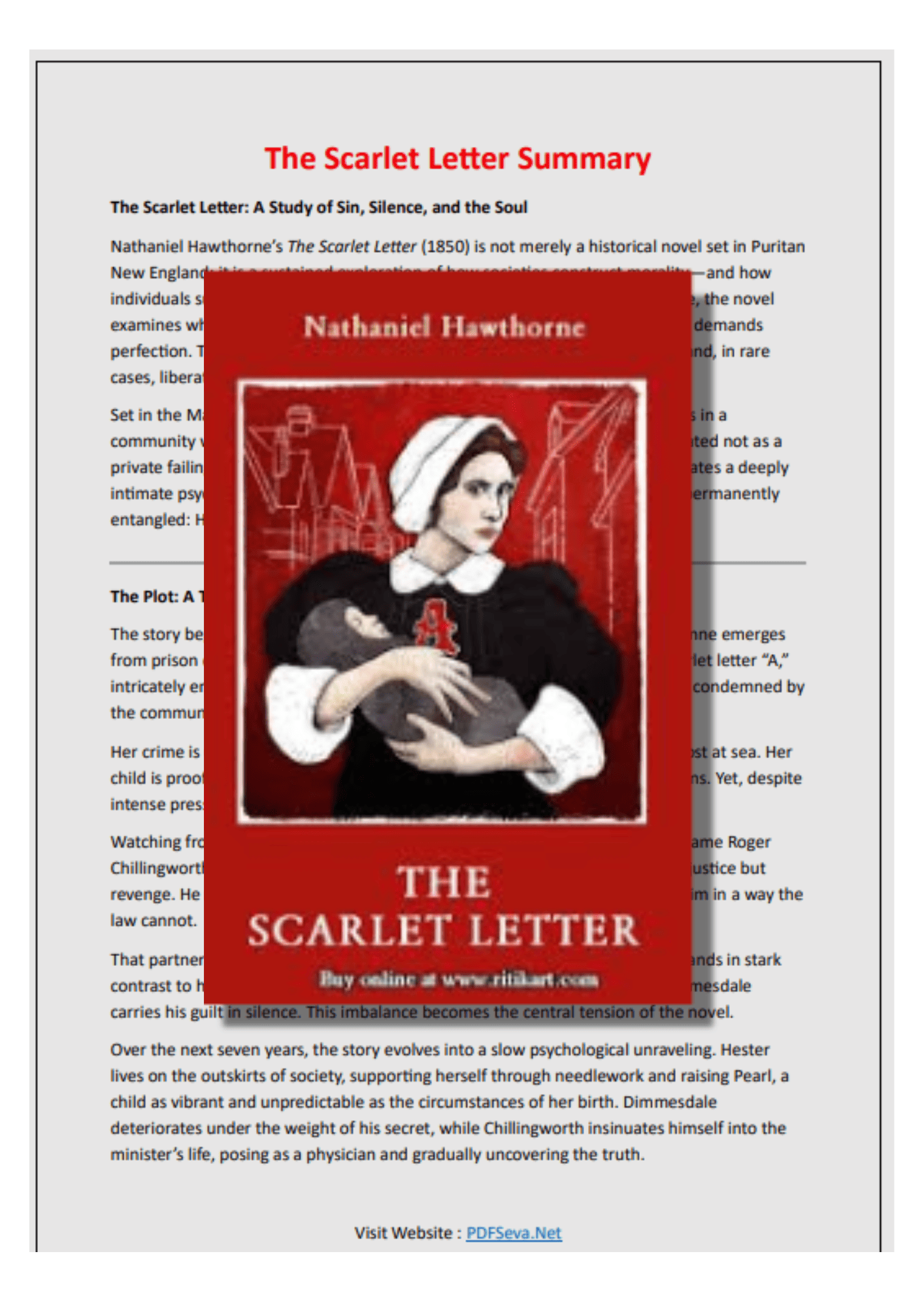
The story begins with a scene that defines everything that follows. Hester Prynne emerges from prison carrying her infant daughter, Pearl. On her chest, she wears a scarlet letter “A,” intricately embroidered in gold thread. This letter marks her as an adulteress, condemned by the community to live as a visible example of sin.
Her crime is undeniable. Her husband had been absent for years, presumed lost at sea. Her child is proof of a relationship that violated the strict moral code of the Puritans. Yet, despite intense pressure, Hester refuses to reveal the identity of the child’s father.
Watching from the crowd is her husband, now returned under the assumed name Roger Chillingworth. Instead of exposing himself, he chooses secrecy. His aim is not justice but revenge. He resolves to discover the identity of Hester’s partner and punish him in a way the law cannot.
That partner is Arthur Dimmesdale, a revered minister whose public image stands in stark contrast to his inner turmoil. While Hester bears her punishment openly, Dimmesdale carries his guilt in silence. This imbalance becomes the central tension of the novel.
Over the next seven years, the story evolves into a slow psychological unraveling. Hester lives on the outskirts of society, supporting herself through needlework and raising Pearl, a child as vibrant and unpredictable as the circumstances of her birth. Dimmesdale deteriorates under the weight of his secret, while Chillingworth insinuates himself into the minister’s life, posing as a physician and gradually uncovering the truth.
The narrative builds toward a powerful climax. After years of concealment, Dimmesdale finally confesses publicly. Standing on the scaffold where Hester once stood alone, he acknowledges his sin, reveals his connection to Pearl, and dies shortly after. Chillingworth, deprived of his purpose, declines and dies as well. Hester survives, ultimately returning to the community and continuing to wear the scarlet letter—not as a punishment, but as a chosen identity.
The Three Pillars of Human Experience
Hawthorne structures the novel around three distinct modes of suffering, each embodied by a central character. Their experiences are not merely personal; they represent different responses to sin, guilt, and moral conflict.
- Hester Prynne: Public Shame
Hester’s punishment is visible and constant. She is forced to confront her actions in the eyes of the community every day. Yet this exposure becomes a strange form of freedom. With nothing left to hide, she develops a quiet strength and a deeply reflective inner life. - Arthur Dimmesdale: Private Guilt
Dimmesdale’s suffering is internal. He is celebrated as a moral leader while privately consumed by shame. This contradiction erodes him physically and spiritually. His eventual confession brings relief, but only at the cost of his life. - Roger Chillingworth: Consuming Revenge
Chillingworth’s transformation is the most chilling. Initially a wronged husband, he becomes entirely defined by his desire for revenge. In pursuing another’s sin, he creates his own—one that corrodes his humanity.
This triad reveals a crucial insight: suffering is not determined by the act itself, but by how it is carried. Public exposure, private concealment, and obsessive retaliation each produce radically different outcomes.
Themes: Beyond the Surface of Sin
The Nature of Sin
In the Puritan worldview, sin is absolute and visible. Hawthorne complicates this simplicity. Hester and Dimmesdale’s act, though condemned, arises from human emotion and vulnerability. Chillingworth’s revenge, by contrast, is cold and deliberate. The novel quietly suggests that not all sins are equal—and that intention matters as much as action.
The Divide Between Public and Private Identity
One of the novel’s most enduring concerns is the gap between how individuals appear and who they truly are. Dimmesdale’s public sanctity hides private despair. Hester’s public disgrace conceals a growing moral clarity. The community, obsessed with appearances, consistently misjudges both.
Civilization and the Wilderness
The town represents order, surveillance, and judgment. The forest represents freedom, ambiguity, and truth. It is in the forest that Hester and Dimmesdale speak honestly, away from the structures that define them. Yet the novel resists the idea that escape is simple. The past cannot be left behind; it must be confronted.
A Deeper Lens: The Scarlet Letter as a Living Symbol
The scarlet letter begins as a fixed symbol of adultery, imposed by the community. Over time, however, it becomes something far more complex.
Its meaning shifts depending on who observes it:
- To the townspeople, it gradually comes to signify ability and resilience.
- To Pearl, it is simply part of her mother’s identity.
- To outsiders, it appears as a mark of distinction rather than shame.
This fluidity transforms the letter into a dynamic symbol—one that resists a single definition. Its most profound transformation occurs within Hester herself. By accepting and redefining the letter, she removes its power to wound her.
A unique way to understand this transformation is to see the letter as a kind of social “interface.” It mediates how others perceive Hester, but it does not fully control her identity. Through her actions, she rewrites its meaning. What begins as a label imposed from the outside becomes a symbol shaped from within.
The Asymmetry of Punishment
An often overlooked aspect of the novel is the imbalance in how justice is distributed:
- Hester is punished publicly but achieves inner stability.
- Dimmesdale is protected publicly but suffers internally.
- Chillingworth escapes formal punishment but experiences moral collapse.
This asymmetry suggests that external justice systems are incomplete. True consequences unfold within the individual, shaped by conscience rather than law.
Pearl: The Living Question
Pearl is more than a character; she is a force within the narrative. Described as the “scarlet letter endowed with life,” she embodies both the consequence of sin and the possibility of truth.
She resists control, questions authority, and refuses to accept partial truths. Her presence forces both Hester and Dimmesdale to confront reality. She will not allow secrecy to remain comfortable.
At the moment of Dimmesdale’s confession, Pearl’s role shifts. Having fulfilled her function as a living reminder, she becomes capable of entering ordinary human society. Her transformation suggests that truth, once acknowledged, releases its hold.
Symbolism: Nature and Meaning
Two recurring symbols deepen the novel’s emotional landscape.
- The Rosebush
Found outside the prison door, the rosebush represents natural grace in contrast to human severity. It suggests that compassion exists even in the harshest environments. - The Scaffold
The scaffold appears at key moments in the story, marking transitions from secrecy to revelation. It is both a place of punishment and a stage for truth.
These symbols reinforce the novel’s central tension between judgment and mercy.
The Climax: Confession and Release
Dimmesdale’s final act of confession is the emotional and moral center of the novel. For years, he has lived divided against himself. By speaking the truth publicly, he unites his inner and outer selves.
His death immediately after this act is not merely tragic; it is also symbolic. He achieves a form of spiritual resolution that was impossible while he remained hidden.
Chillingworth, deprived of his purpose, quickly declines. His identity was built entirely around another man’s suffering. Without it, he has nothing left.
Hester’s survival offers a different kind of resolution. She does not escape her past, nor does she erase it. Instead, she integrates it into her identity.
The Ending: Choice, Not Punishment
Years after the central events, Hester returns to the community and resumes wearing the scarlet letter. This choice is crucial. The letter no longer represents external judgment; it reflects personal history and self-understanding.
Women in the community begin to seek her counsel, recognizing her as someone who has endured and understood suffering. The symbol that once isolated her now connects her to others.
This transformation marks the novel’s final insight: identity is not fixed by a single act or a single label. It evolves through experience, reflection, and choice.
Why The Scarlet Letter Still Matters
The enduring relevance of The Scarlet Letter lies in its exploration of themes that remain deeply familiar: public shaming, private guilt, and the struggle to define oneself in the face of societal expectations.
It raises a question that continues to resonate:
Is it better to live openly with one’s flaws, or to hide them behind a carefully constructed image?
Hester’s life suggests that truth, even when painful, creates the possibility of growth. Dimmesdale’s fate warns of the cost of concealment. Chillingworth’s transformation reveals the danger of allowing resentment to define one’s existence.
Final Reflection
At its heart, The Scarlet Letter is not simply a story about sin. It is a meditation on identity—how it is shaped, challenged, and ultimately reclaimed.
Hester Prynne’s journey illustrates that meaning is not permanently assigned. Even the most rigid symbol can be reinterpreted. Even the harshest judgment can be transformed.
The scarlet letter begins as a mark of exclusion. It ends as a testament to resilience.
And in that transformation lies the novel’s quiet but enduring power.