Form 121 Income Tax PDF – Complete Guide, Meaning, Eligibility & Download : Form 121 income tax is a newly introduced consolidated declaration form that replaces the earlier Forms 15G and 15H. It allows eligible taxpayers to submit a self-declaration to avoid Tax Deducted at Source (TDS) when their total estimated income falls below the taxable limit.
The form 121 income tax pdf download is now widely available through official government and banking portals. It simplifies compliance by merging two commonly used forms into a single unified document, making the process easier for both taxpayers and financial institutions.
What is Form 121 in Income Tax?
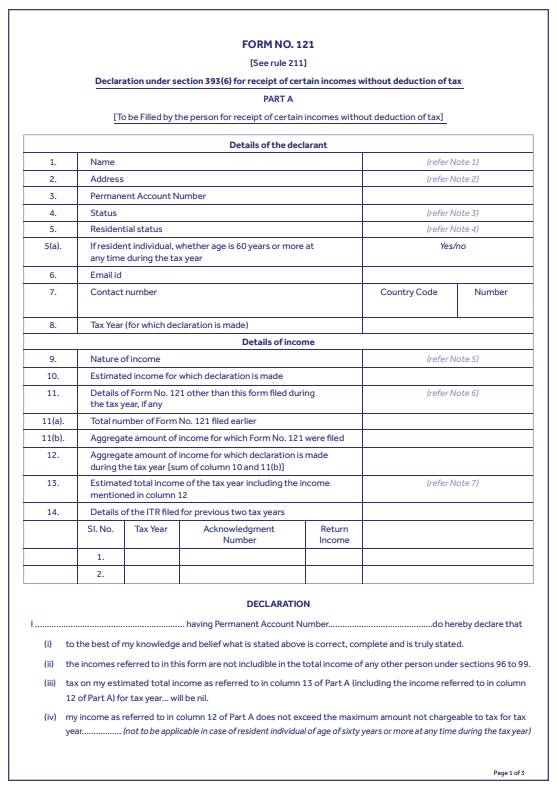
Form 121 is a self-declaration form under Section 393(6) of the Income-tax framework, used by individuals and Hindu Undivided Families (HUFs) to declare that their total income is not taxable. Based on this declaration, banks or other payers do not deduct TDS on specified incomes.
It has replaced:
- Form 15G (for individuals below 60 years)
- Form 15H (for senior citizens)
This consolidation improves efficiency and reduces duplication in tax reporting systems.
Purpose of Form 121
The primary purpose of Form 121 is to ensure that tax is not deducted unnecessarily when the taxpayer’s income is below the exemption limit.
It applies to income such as:
- Bank interest and fixed deposits
- Post office deposits
- Dividends
- Insurance payouts
- Rent or other specified payments
Submitting this form prevents unnecessary TDS deductions and avoids the need to claim refunds later.
Eligibility Criteria
To use Form 121, the following conditions must be met:
- Must be a resident individual or HUF
- Total estimated income for the financial year must be below taxable limit
- Final tax liability should be nil
- A valid PAN is mandatory
- Non-residents, companies, and firms are not eligible
Key Details of Form 121
Form 121 includes two main sections:
Part A (Filled by the Declarant)
- Personal details (Name, PAN, address, contact)
- Residential status and tax year
- Estimated income details
- Previous tax return information
- Declaration confirming nil tax liability
Part B (Filled by the Payer)
- Details of the payer (bank/company)
- Unique Identification Number (UIN)
- Record of declaration received
- Verification by authorized person
This structured format ensures accurate reporting and compliance.
Practical Usage and Benefits
Form 121 offers several practical advantages:
- Avoids TDS deduction when not applicable
- Reduces the need to file refund claims
- Simplifies tax compliance for individuals and seniors
- Enables better tracking through UIN and reporting systems
- Supports digital submission via banking portals
The form must be submitted to each payer (bank, company, or institution) where income is expected.
Validity and Submission Rules
- Valid for one financial year only
- Must be submitted before the first income payment or credit
- Can be submitted online or offline, depending on the institution
- Requires fresh submission every year
Timely submission ensures uninterrupted benefit of non-deduction of TDS.
Official Download Links for Form 121 PDF
The form 121 income tax pdf download is available through:
- Income Tax Department: Available on the Official Forms Download Page.
- State Bank of India (SBI)
- RBL Bank
- DCB Bank
- IDBI Bank
These sources provide updated and valid versions of the form for submission.
Frequently Asked Questions (FAQs)
1. What is Form 121 in income tax?
Form 121 is a consolidated self-declaration form that replaces Forms 15G and 15H, allowing eligible taxpayers to avoid TDS if their income is below the taxable limit.
2. Who can submit Form 121?
Resident individuals and HUFs with nil tax liability and income below the exemption limit can submit Form 121.
3. Is Form 121 mandatory every year?
Yes, the form must be submitted at the beginning of each financial year or before receiving income.
4. Can Form 121 be submitted online?
Yes, many banks and financial institutions allow online submission through internet banking.
5. Does submitting Form 121 mean income is tax-free?
No, it only prevents TDS deduction. Income may still be taxable if it exceeds limits.