If you are a business owner or taxpayer who disagrees with a government tax decision or penalty, you might need to use a Tribunal Application Form. Here is a plain-English breakdown of what this document is, why it matters, and how it works.
What is a Tribunal Application Form?
Simply put, it is an official document you use to formally disagree with a ruling made by a lower government authority. By filling this out, you are asking a higher legal authority (the tribunal) to review your case and change the original decision.
Tribunal Application Form pdf
| Form Name | Category | Download |
|---|---|---|
| Form: 10(B) | Application For Revision/ Second Appeal Under CST ( English ) | Download |
| Form: 10(B) | Application For Revision/ Second Appeal Under CST ( Gujarati ) | Download |
| Form 501 | Application for Appeal/second Appeal | Download |
| Form 502 | Application for Revision under section 75 of the Gujarat Value Added Tax Act, 2003. | Download |
People typically use this form to challenge:
- Unfair tax bills
- Unexpected penalties
- Previous appeal decisions that didn’t go their way
Why is this Form Used?
- To Get a Fair Hearing: It gives you a way to fight back if you believe an authority made a mistake.
- To Follow the Law: It provides a clear, legal path for making an appeal.
- To Keep Things Transparent: It ensures your dispute is officially recorded and verified.
- To Stay Compliant: It helps you properly navigate strict tax laws without breaking the rules.
The Legal Framework
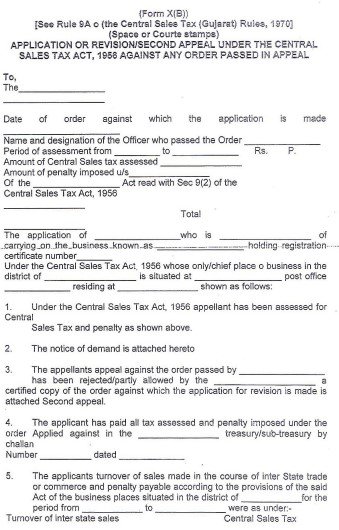
For the specific form you are looking at, the rules come from the Central Sales Tax Act of 1956 (specifically Section 9(2)) and the Gujarat Sales Tax Rules (Rule 9A). These laws officially give you the right to appeal unfair tax assessments or penalties.
Breaking Down the Form: Section by Section
To fill out the form correctly, you will need to provide specific information. Here is what each part of the form is actually asking for:
1. Title and Legal Reference This section simply states the specific laws your appeal falls under. It proves your application is legally valid.
2. Your Details Basic information to identify you in the legal system: your full name, your business’s name, your registration/certificate number, and your address.
3. The Decision You Are Challenging You need to explain exactly what you are fighting. This includes the date of the original decision and the name and job title of the officer who made it.
4. The Money Involved This is where you list the exact financial numbers being disputed, including the original tax amount assessed, any penalties added, and the total they claim you owe.
5. The Timeframe (Assessment Period) You must specify the exact dates (start and end) for the tax period that is being debated.
6. Your Appeal History The tribunal needs to know the whole story. You will note if you have already tried to appeal this decision, what the result was, and provide a copy of that previous ruling.
7. Proof of Payment Even when disputing a bill, you often have to pay certain fees or undisputed tax amounts first. Here, you will provide the receipt details (like the treasury details and Challan number) to prove you have made those payments.
8. Your Sales Figures (Turnover) Because this involves sales tax, you must declare your total business sales across state lines, along with the tax and penalty amounts tied to those sales.
9. Proof of Good Behavior This is a statement confirming that you have been playing by the rules—meaning you have filed your regular tax returns and responded to any previous official notices.
10. Your Argument (Grounds for Application) This is the most critical part of the form. This is where you make your case. You need to clearly explain why you are appealing, point out exactly where the original officer made a mistake, and present your legal arguments. A strong, clear argument here is your best chance at winning the appeal.