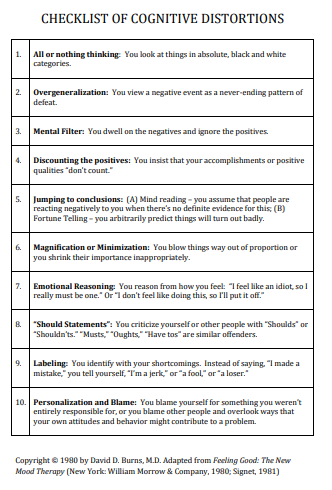
Cognitive Distortions pdf free download: Cognitive distortions are inaccurate thinking patterns that negatively influence how you interpret situations, feel emotions, and make decisions. If you’re looking for a Cognitive Distortions PDF, this guide explains what they are, provides real-life examples, and shows practical ways to challenge them—based on widely used therapist worksheets.
What Are Cognitive Distortions?
Cognitive distortions are irrational or biased thoughts that can lead to anxiety, stress, and negative self-beliefs. These thinking patterns are common and normal, but when they become frequent, they can affect mental well-being.
In simple terms:
- You interpret reality in a distorted way
- Your thoughts become overly negative or unrealistic
- Your emotions and actions follow those distorted thoughts
For example, thinking “I failed once, so I’m a failure” is not a fact—it’s a distortion.
Common Cognitive Distortions (With Examples)
1. All-or-Nothing Thinking
Seeing things in extremes, with no middle ground.
Example: “If I’m not perfect, I’m a total failure.”
2. Overgeneralization
Drawing broad conclusions from a single event.
Example: “I messed up once, I always mess up.”
3. Catastrophizing
Expecting the worst possible outcome.
Example: “This mistake will ruin everything.”
4. Mental Filter
Focusing only on the negative and ignoring positives.
Example: Ignoring praise and focusing on one criticism.
5. Disqualifying the Positive
Rejecting positive experiences as unimportant.
Example: “Anyone could have done that—it doesn’t count.”
6. Mind Reading
Assuming what others think without evidence.
Example: “They think I’m not good enough.”
7. Fortune Telling
Predicting negative outcomes without proof.
Example: “This will definitely go wrong.”
8. Emotional Reasoning
Believing feelings are facts.
Example: “I feel useless, so I must be useless.”
9. “Should” Statements
Setting rigid expectations.
Example: “I should never make mistakes.”
10. Personalization
Blaming yourself for things outside your control.
Example: “It’s my fault they are upset.”
Why Cognitive Distortions Matter
Unchecked distorted thinking can lead to:
- Anxiety and stress
- Low self-esteem
- Depression patterns
- Poor decision-making
Recognizing these patterns is the first step toward healthier thinking.
How to Challenge Cognitive Distortions
1. Identify the Distortion
Notice the negative thought and label it (e.g., “This is catastrophizing”).
2. Examine the Evidence
Ask yourself:
- What proof supports this thought?
- What proof contradicts it?
3. Replace With Balanced Thinking
Instead of: “I always fail”
Try: “Sometimes I make mistakes, but I also succeed.”
4. Use a Continuum Scale
Rate situations from 0–100 instead of extremes.
5. Talk to Yourself Like a Friend
Replace harsh self-talk with compassionate language.
6. Behavioral Experiments
Test your thoughts in real life to see if they are true.
What’s Included in a Cognitive Distortions PDF?
A good cognitive distortions PDF (therapist aid style) usually includes:
- List of distortions with definitions
- Real-life examples
- Thought-record worksheets
- Exercises to challenge negative thinking
- Reflection and journaling prompts
These resources are widely used in CBT (Cognitive Behavioral Therapy).
FAQ
What are cognitive distortions in simple words?
Cognitive distortions are negative or irrational thought patterns that make you see situations inaccurately, often leading to stress or anxiety.
What is an example of a cognitive distortion?
An example is catastrophizing—thinking that a small mistake will lead to a major failure.
How do you stop cognitive distortions?
You can stop them by identifying the thought, checking evidence, and replacing it with a balanced and realistic perspective.
Are cognitive distortions normal?
Yes, everyone experiences them occasionally, but frequent distortions can affect mental health.