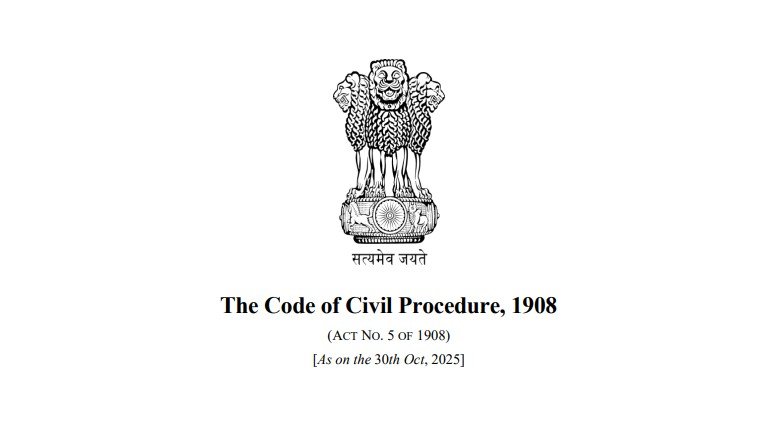
The CPC Bare Act, officially known as The Code of Civil Procedure, 1908 (Act No. 5 of 1908), is the backbone of India’s civil justice system. This comprehensive legislation consolidates and amends the laws relating to the procedure of the Civil Courts.
The CPC Bare Act PDF provides step-by-step procedural rules that guide how civil suits are filed, heard, decided, appealed, and executed. From jurisdiction to appeals, from institution of suits to execution of decrees, this act lays down an exhaustive procedural framework for every civil case in India.
What is CPC? – Introduction
the CPC begins with:
“An Act to consolidate and amend the laws relating to the procedure of the Courts of Civil Judicature.” A1908-05
Enacted in 1908 and enforced from 1st January 1909, the CPC governs:
- How civil suits are filed
- How notices/summons are issued
- How evidence is recorded
- How judgments and decrees are passed
- How orders are executed
- How appeals, revisions, and reviews work
The PDF also lists the long history of amendments from 1914 to 2025, showing how the act has evolved. Examples include:
- CPC Amendment Act 1976
- CPC Amendment Act 1999
- Commercial Courts Act 2015
… and many more amendments listed in your PDF.
Structure of CPC Bare Act
✔️ 1. Arrangement of Sections (Preliminary to Miscellaneous)
✔️ 2. Eleven Parts (Part I to Part XI)
✔️ 3. First Schedule – with 51 Orders
✔️ 4. Appendices A to I
✔️ 5. List of Amending Acts (52 items)
✔️ 6. List of Abbreviations and Legal Short Forms
All these elements are used in the explanation below.
Detailed Section-Wise Explanation of CPC Bare Act
- Preliminary (Sections 1–2)
- Section 1 – Short title, commencement, extent
- Act name: Code of Civil Procedure, 1908
- Comes into force: 1 January 1909
- Extends to whole of India, except certain tribal areas (with special exemptions explained in your PDF). A1908-05
- Section 2 – Definitions
This includes detailed definitions of important terms such as:
- Decree
- Judgment
- Order
- Foreign Court
- Pleading
- Mesne profits
The Act explains:
A decree is the formal expression of adjudication which conclusively determines the rights of the parties. A1908-05
This definition is central to understanding the entire CPC.
⚖️ PART I – Suits in General (Sections 9–35B)
📍 A. Jurisdiction of Courts
- Section 9: courts can try all civil suits unless barred
- Section 10: stay of suit
- Section 11: res judicata
- Section 13–14: foreign judgments
📍 B. Place of Suing (Sections 15–20)
Rules on where a suit should be filed depending on:
- Defendant’s residence
- Location of property
- Place where cause of action arises
📍 C. Institution of Suits (Section 26)
A suit is instituted by filing a plaint.
📍 D. Summons (Sections 27–32)
• Notice to the defendant
• Service of summons in different states
• Service of foreign summons
📍 E. Judgment & Decree (Section 33)
Judgment must be followed by a decree.
📍 F. Costs (Sections 35–35B)
Includes compensatory costs for false/vexatious claims.
PART II – Execution (Sections 36–74)
This is one of the most detailed portions in your PDF.
Key areas include:
- Which court may execute a decree (Section 38)
- Transfer of decree (Section 39–40)
- Arrest & detention rules (Sections 55–59)
- Attachment of property (Sections 60–64)
- Sale of attached property (Sections 65–73)
Section 60 lists which properties can and cannot be attached.
PART III – Incidental Proceedings (Sections 75–78)
Covers Commissions issued by courts for:
- examining witnesses
- conducting local investigations
- performing scientific investigations
PART IV – Suits in Particular Cases (Sections 79–88)
Includes suits:
- by or against government
- against foreign rulers
- interpleader suits
- notice requirements (Section 80)
PART V – Special Proceedings (Sections 89–93)
Alternative dispute resolution methods (ADR):
- Arbitration
- Conciliation
- Lok Adalats
Section 89 is widely used for promoting settlements outside courts.
PART VI – Supplemental Proceedings (Sections 94–95)
Allows courts to:
- issue temporary injunctions
- order arrest
- attach property
- appoint receivers
PART VII – Appeals (Sections 96–112)
Explains:
- first appeals
- second appeals
- appeals to Supreme Court
- powers of appellate courts
PART VIII – Reference, Review & Revision (Sections 113–115)
Important remedies available after judgment:
- Reference to High Court
- Review of judgment
- Revision petitions
PART IX – High Court Provisions (Sections 116–120)
Special procedures for High Courts with original civil jurisdiction.
PART X – Rules (Sections 121–131)
Empowers High Courts to frame rules.
PART XI – Miscellaneous (Sections 132–158)
Includes:
- exemption from arrest
- amendment of judgments
- court language
- caveat rules (Section 148A)
First Schedule – 51 Detailed Orde
Your CPC Bare Act PDF includes all 51 Orders, for example:
- Order I: Parties to suits
- Order II: Frame of suit
- Order III: Recognized agents and pleaders
- Order V: Issue and service of summons
- Order VII: Plaint
- Order VIII: Written statement, set-off, counterclaim
- Order IX: Appearance of parties
- Order XXI: Execution of decrees
- Order XXXIX: Temporary injunctions
- Order XLIII: Appeals
- Order XLVII: Review
Each order contains multiple rules that dictate step-by-step civil court process.
Appendices A to I (Included in PDF)
These include:
- Pleading formats
- Process forms
- Decree templates
- Execution forms
- Statement of Truth format
Everything necessary for practical court usage.
Importance of CPC Bare Act PDF for Students, Lawyers & Competitive Exams
The CPC is essential for:
✔️ Judiciary Exams (Civil Judge, JMFC, ADJ)
✔️ UPSC Law Optional
✔️ CLAT / LL.B. / LL.M.
✔️ Practicing Lawyers
✔️ Law Interns & Researchers
This acts as a ready reference for all procedural aspects of civil cases.
Detailed Answer-Style Explanation
It is the authoritative document containing the entire Code of Civil Procedure, 1908 including:
sections
orders
rules
amendments
schedules
appendices
(as visible in your uploaded document). A1908-05
Because every civil dispute in India—property, contract, partition, divorce, injunction, recovery—follows CPC rules.
It contains 158 sections + 51 orders + 9 appendices.
Your uploaded PDF is updated till 30 October 2025 making it one of the most useful recent versions.