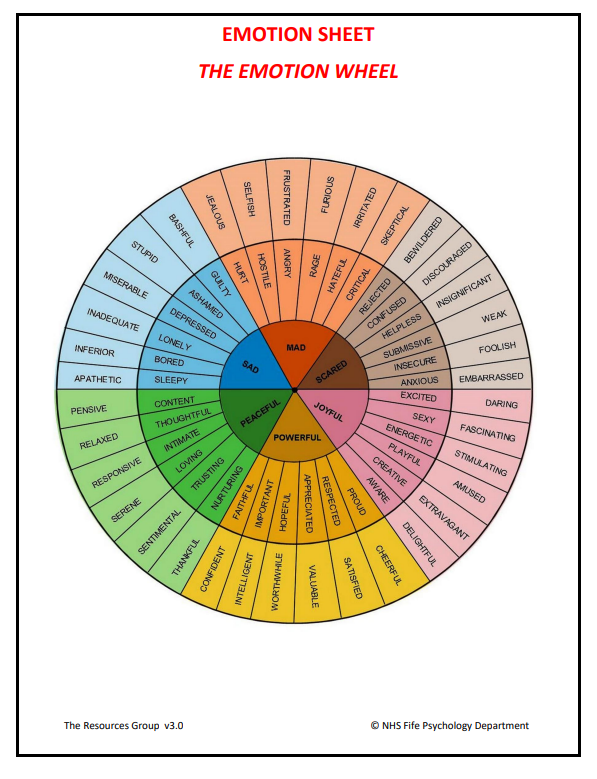
Emotion Wheel PDF Free Download Here: Understanding emotions is not always straightforward. Human beings often experience multiple emotions simultaneously, and at times, struggle to clearly identify what they are feeling or why. Popular psychology, including the animated film Inside Out, illustrates how layered and complex emotional experiences can be. In real life, however, this complexity can feel overwhelming.
Research suggests that humans may experience anywhere from 27 to over 30,000 distinct emotional states, depending on how emotions are classified. Even the most self-aware individuals can find it difficult to accurately name and process these feelings. This is where the Emotion Wheel PDF becomes a valuable tool for emotional clarity and self-awareness.
What Is the Emotion Wheel?
The Emotion Wheel is a visual framework designed to simplify and organize human emotions. Developed by psychologist Robert Plutchik, the model explains emotions by grouping them into core categories and showing how they evolve into more nuanced emotional states.
Plutchik identified eight primary emotions that form the foundation of all emotional experiences:
- Joy
- Sadness
- Anger
- Fear
- Disgust
- Trust
- Surprise
- Anticipation
These core emotions appear at the center of the wheel. As emotions become less intense or more complex, they radiate outward into secondary and tertiary emotions.
How the Emotion Wheel Works
Emotion wheels are typically illustrated as colorful, flower-like diagrams. The innermost circle represents primary emotions, while outer layers display increasingly subtle variations. For example, irritation is considered a milder form of anger, and disappointment is a softer expression of sadness.
This structure helps users identify not only what they feel, but also how strongly they feel it.
Primary and Secondary Emotions Explained
Sadness
Includes grief, regret, reflection, hurt, rejection, melancholy, discouragement, and depression.
Disgust
Covers feelings such as revulsion, disdain, criticism, dismissal, hatred, and disapproval.
Anger
Ranges from irritation and frustration to rage, bitterness, offence, and provocation.
Anticipation
Includes interest, vigilance, excitement, impatience, expectation, caution, and alertness.
Joy
Encompasses contentment, pleasure, pride, serenity, satisfaction, jubilation, and ecstasy.
Fear
Includes worry, stress, nervousness, apprehension, dread, and caution.
Surprise
Covers astonishment, wonder, shock, disbelief, awe, and speechlessness.
Trust
Consists of security, optimism, comfort, vulnerability, support, and emotional ease.
These distinctions naturally appear in daily communication. For example, saying “I’m disappointed, not sad” reflects an intuitive use of the Emotion Wheel by identifying a secondary emotion rather than a core one.
Emotion Wheel vs Feeling Wheel
The original Feeling Wheel was created in 1982 by Gloria Willcox and focused on six core emotions. Later adaptations expanded this model to include a broader emotional spectrum.
Plutchik’s Emotion Wheel, proposed in 1980, differs primarily in the number of core emotions and the way emotional intensity is represented. Technically, the term Feeling Wheel refers to the Willcox model, while Emotion Wheel refers to Plutchik’s framework.
Why the Emotion Wheel Is Useful
1. Improves Emotional Literacy
The Emotion Wheel helps individuals accurately label emotions, making it easier to express feelings in personal and professional contexts.
2. Encourages Self-Awareness
By identifying emotional triggers and intensity, users can better understand emotional patterns and responses.
3. Supports Behavioral Insight
According to Plutchik, emotions exist to drive survival-oriented actions. Fear may prompt avoidance, anger may encourage defense, and joy may reinforce beneficial behavior.
The Science Behind Emotional Responses
Human emotions are not random reactions; they are deeply connected to brain processes and survival mechanisms. The fight-or-flight response is a classic example, where fear or anger prepares the body for immediate action.
Modern neuroscience expands on this idea. In How Emotions Are Made, Lisa Feldman Barrett explains that emotions are constructed by the brain based on past experiences, bodily signals, and environmental context. While her theory differs from Plutchik’s in some respects, both perspectives emphasize that emotions carry valuable information.
For instance, a racing heartbeat could signal fear, excitement, or anger depending on context. Understanding this distinction allows individuals to respond thoughtfully rather than react impulsively.
How to Use the Emotion Wheel PDF
- Pause and identify your current feeling
- Locate the closest primary emotion on the wheel
- Move outward to identify secondary or tertiary emotions
- Reflect on the underlying need or trigger
- Choose a response aligned with awareness rather than impulse
Using an Emotion Wheel PDF free download regularly can improve emotional regulation, communication, and personal growth.
Conclusion
The Emotion Wheel is more than a diagram—it is a practical tool for emotional intelligence. By clarifying what we feel and why we feel it, the wheel empowers us to address underlying needs and make conscious choices. With consistent use, it enables a shift from reactive behavior to intentional response, fostering deeper self-understanding and emotional balance.